We have been called a People of the Book for nearly 1400 years. We did not invent the term. It was given to us (as well as to Christians) by our cousins the Muslims. Nonetheless, even as our technologies move us beyond the physical book, the text remains. We return to the text that has served as the humus from which we draw our nourishment (n.b. not hummus, though it is also very nourishing).
now is the time of turning
The next to last verse of the Book of Lamentations (5:21) reads:
השׁיבנו יהוה אליך ונשוב (וְנשׁובה), חדשׁ ימינו כקדם.
It is commonly translated:
Turn Thou us unto Thee, O LORD, and we shall be turned; renew our days as of old.
I have long had difficulty with this verse. I wonder why we would want to return to what had been and not move forward to something yet to be. As you can see in the left sidebar, i.e. some sayings of ר‘משבצונה“ל
השיבהו ח‘ אליך ונשובה חדש ימינו כעוד לא היו.
I have changed the text to align more closely to my understanding of how the future should be new, not old.
In her recent post on the subject, Rabbi Rachel Gurevitz shares R. Zalman Shachter-Shalomi’s translation of the verse: Take us back, O God, to Yourself, and let us come back; Renew our days as of old. I find this slightly better. However, it is in the explication by R. Gurewitz that I find greater meaning. (Full disclosure, though we have met and appreciate each others works, our names are merely similar and we are only related in the same way that all now descended from those who settled in Hořovice are related.) We need as R. Gurewitz writes:
what Zen practice calls Shoshin — ‘beginner’s mind.’ To do so requires an awareness that the way we responded to a situation before, based on our own histories, experiences, assumptions, etc. is not a given.
This is similar to what R. Morris Lichtenstein of the Society for Jewish Science expresses:
The old year is soon to pass. One more link shall have been added to the chain of our experience, another milestone in the road to our goal shall have been passed. We shall have risen one level higher, perhaps, in our aspiration to realize the values of life. Astronomers count the completion of a year as a great event in nature; the earth has made a complete circuit around the sun. But when the year ends the earth returns to its original place. It would be no less than a calamity, if we should find ourselves at the end of the year on the very same spot where we began. We must advance with the flow of time, we must grow; we must not falter, but leave a trail of progress upon the fleeting days. To the shrub a year means but an additional leaf, to the vine it means only a new cluster, to the tree a new ring of bark, to the stream it means a deeper flow. But to us a year may mean new knowledge mastered, new thoughts brought into action, new feelings set in motion, a clearer understanding of God, a closer communion with God. If this is what this New Year shall mean to us all, then shall we all have indeed a year of blessedness and fulfillment.
we return once again to The Garden
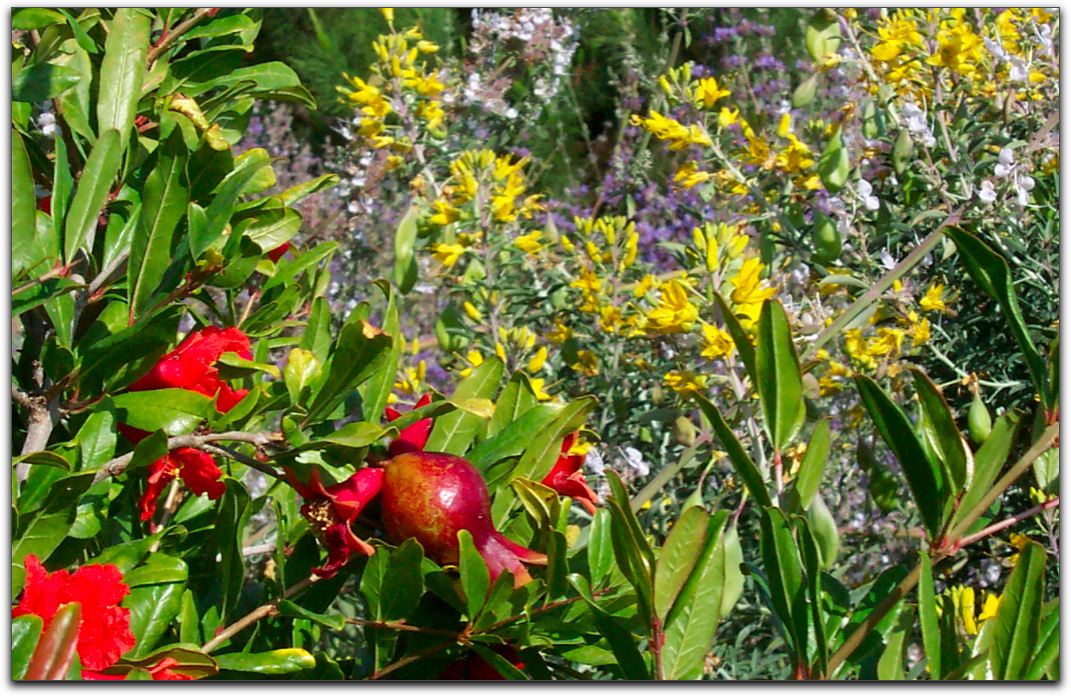
our San Diego home garden
The September 21, 2009 issue of The Nation has an article by Michael Pollan in which he refers to Wendell Berry’s comment that eating is an agricultural act.
For what would we give today to have back the “environmental crisis” that Berry wrote about so prophetically in the 1970s, a time still innocent of the problem of climate change? Or to have back the comparatively manageable public health problems of that period, before obesity and type 2 diabetes became “epidemic”? (Most experts date the obesity epidemic to the early 1980s.)
When Debbie and I were newlyweds and moved to Jerusalem for the first year of our rabbinic studies in 1973 we took very few things with us. Among the books we brought, one we used more than most was Recipes for a Small Planet. We continue to use recipes and methods we learned from it.

The cover of our edition was blue
As I wrote a couple of weeks ago:
Not only with our gardens, so also with us. The time has come to turn over, but more than a new leaf or a little soil. Or perhaps we should turn around, but not in the manner of our puppies that chase their tails running around in circles as they distract us in our garden. Nor in the manner of the snakes in our garden, the Ouroboros the snake with its tail in its mouth, forming a never ending circle. No, I cannot simply toss off a bit of old skin as the snake simply loses its, but remain essentially the same.
We need to reach farther than the beauty that is skin-deep. Sometimes the pipes that lay beneath our gardens develop cracks. Roots and detritus find their way in and clog the flow of irrigating waters. There are times when it becomes so serious that we need to call for help and the company comes that snakes through the piping, routing out the accumulated debris. So it is with us. We need to reach into our hearts and turn them, cleanse our thickening arteries, open them to freshness, enable them to flow freely with the fluids that bring fresh life.
turn it and turn it
Our literature encourages us to turn and look at life and our literature itself, as if it were living soil, from as many perspectives as possible. in Pirke Avot 5:19 [21]…
ה,יט [כא] בן בגבג אומר, הפוך בה והפך בה, והגי בה דכולא בה
Ben Bag Bag said, “Turn it and turn it, for everything is in it.”
turn, turn, turn
Turn it and turn it, also as in the wheels of a bicycle.

un-turning
A name some Jews have taken on as their own: The People of the Bike. This weekend is the annual New York Jewish Environmental Bike Ride.
Avigail works for Hazon. Last year Debbie and I joined her and worked as “crew” (the people “off” the bike).

the people “off” the bike
The morning of the return to NYC we set the bikes out on the damp morning lawn for the riders to find them.
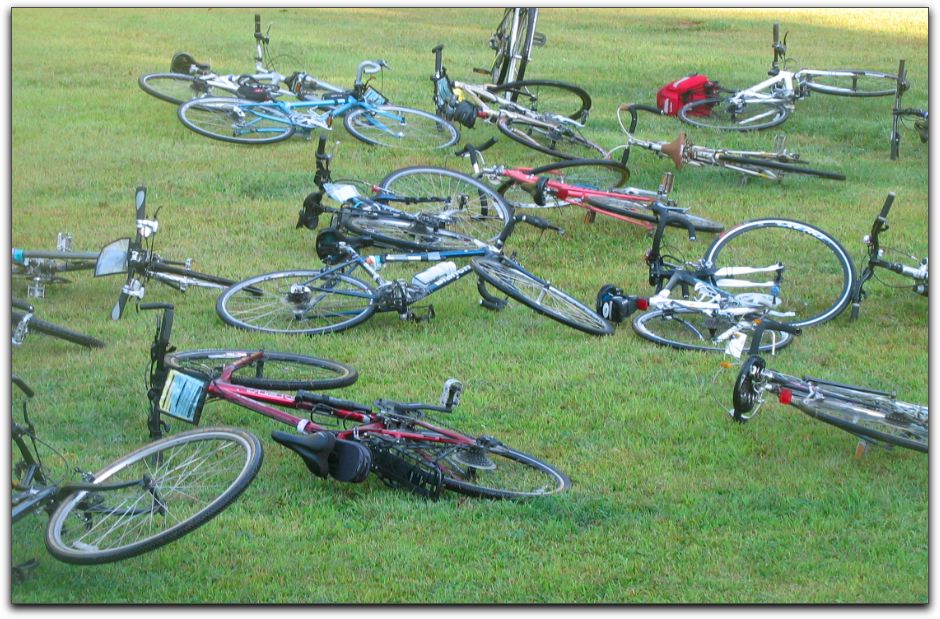
bikes at rest
This year Noam decided he wanted to do the ride. Debbie and I went up to Camp Kinder Ring to join Hazon for a restful and joyous Shabbat. Today, Sunday, September 6 he road 80 miles.
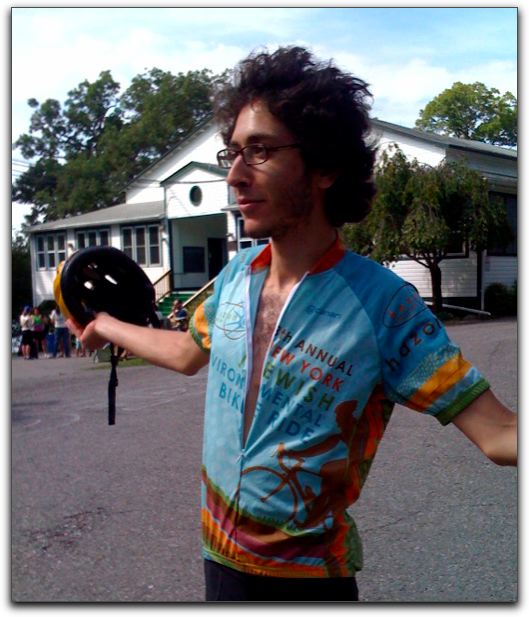
Noam returns to Camp Kinder Ring after riding 80 miles (taken and sent by Avigail using her iPhone)
I was reminded by our colleague R. Jeffrey Salkin that this week marks the 60th anniversary of the Peekskill Riots. Peekskill is about two thirds of the way from NYC to Camp Kinder Ring. I remember the previous year getting goosebumps as I saw the sign for Peekskill from the railroad train on the way to the bike ride. This year, as I drove up the Taconic State Parkway at 55 miles per hour I was more attentive to the nature of the roads and the terrain, imagining what it must have been like to drive a full day from the city (going about 40 MPH maximum). And then, at the end of the day….
Even though it happened on the other side of the continent, the Hurvitz Kids grew up knowing the song that Pete Seeger and Lee Hayes wrote “Hold the Line”. I remember Pete singing the song on one of the many “LPs” we owned. Now, after 60 years I am reassured to know that a new generation of socially aware Jews can move freely in the area and raise awareness of the issues that face us.
I went to our local bike shop at 69th and 2nd Ave. I asked the proprietor to take my photo in the shop. He thought I was a bit strange. The button is made by Hazon, many people wore them on Shabbat.

at our neighborhood bike shop
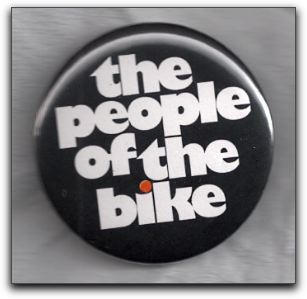
the people of the bike
| Date: | 2008 |
| Size: | 3.5 |
| Pin Form: | clasp |
| Print Method: | celluloid |
| Text | the people of the bike |
your lapel buttons
Many people have lapel buttons. They may be attached to a favorite hat or jacket you no longer wear, or poked into a cork-board on your wall. If you have any laying around that you do not feel emotionally attached to, please let me know. I preserve these for the Jewish people. At some point they will all go to an appropriate museum. You can see all the buttons shared to date.