The People of the…

We have been called a Peo­ple of the Book for near­ly 1400 years. We did not invent the term. It was giv­en to us (as well as to Chris­tians) by our cousins the Mus­lims. Nonethe­less, even as our tech­nolo­gies move us beyond the phys­i­cal book, the text remains. We return to the text that has served as the humus from which we draw our nour­ish­ment (n.b. not hum­mus, though it is also very nourishing).

now is the time of turning

The next to last verse of the Book of Lamen­ta­tions (5:21) reads:
השׁיבנו יהוה אליך ונשוב (וְנשׁובה), חדשׁ ימינו כקדם.
It is com­mon­ly translated:
Turn Thou us unto Thee, O LORD, and we shall be turned; renew our days as of old.
I have long had dif­fi­cul­ty with this verse. I won­der why we would want to return to what had been and not move for­ward to some­thing yet to be. As you can see in the left side­bar, i.e. some say­ings of ר‘משבצונה“ל
השיבהו ח‘ אליך ונשובה חדש ימינו כעוד לא היו.
I have changed the text to align more close­ly to my under­stand­ing of how the future should be new, not old.
In her recent post on the sub­ject, Rab­bi Rachel Gure­vitz shares R. Zal­man Shachter-Shalomi’s trans­la­tion of the verse: Take us back, O God, to Your­self, and let us come back; Renew our days as of old. I find this slight­ly bet­ter. How­ev­er, it is in the expli­ca­tion by R. Gure­witz that I find greater mean­ing. (Full dis­clo­sure, though we have met and appre­ci­ate each oth­ers works, our names are mere­ly sim­i­lar and we are only relat­ed in the same way that all now descend­ed from those who set­tled in Hořovice are relat­ed.) We need as R. Gure­witz writes:

what Zen prac­tice calls Shoshin — ‘beginner’s mind.’ To do so requires an aware­ness that the way we respond­ed to a sit­u­a­tion before, based on our own his­to­ries, expe­ri­ences, assump­tions, etc. is not a given.

This is sim­i­lar to what R. Mor­ris Licht­en­stein of the Soci­ety for Jew­ish Sci­ence expresses:

The old year is soon to pass. One more link shall have been added to the chain of our expe­ri­ence, anoth­er mile­stone in the road to our goal shall have been passed. We shall have risen one lev­el high­er, per­haps, in our aspi­ra­tion to real­ize the val­ues of life. Astronomers count the com­ple­tion of a year as a great event in nature; the earth has made a com­plete cir­cuit around the sun. But when the year ends the earth returns to its orig­i­nal place. It would be no less than a calami­ty, if we should find our­selves at the end of the year on the very same spot where we began. We must advance with the flow of time, we must grow; we must not fal­ter, but leave a trail of progress upon the fleet­ing days. To the shrub a year means but an addi­tion­al leaf, to the vine it means only a new clus­ter, to the tree a new ring of bark, to the stream it means a deep­er flow. But to us a year may mean new knowl­edge mas­tered, new thoughts brought into action, new feel­ings set in motion, a clear­er under­stand­ing of God, a clos­er com­mu­nion with God. If this is what this New Year shall mean to us all, then shall we all have indeed a year of blessed­ness and fulfillment.

we return once again to The Garden

our San Diego home garden

our San Diego home garden

The Sep­tem­ber 21, 2009 issue of The Nation has an arti­cle by Michael Pol­lan in which he refers to Wen­dell Berry’s com­ment that eat­ing is an agri­cul­tur­al act.

For what would we give today to have back the “envi­ron­men­tal cri­sis” that Berry wrote about so prophet­i­cal­ly in the 1970s, a time still inno­cent of the prob­lem of cli­mate change? Or to have back the com­par­a­tive­ly man­age­able pub­lic health prob­lems of that peri­od, before obe­si­ty and type 2 dia­betes became “epi­dem­ic”? (Most experts date the obe­si­ty epi­dem­ic to the ear­ly 1980s.)

When Deb­bie and I were new­ly­weds and moved to Jerusalem for the first year of our rab­binic stud­ies in 1973 we took very few things with us. Among the books we brought, one we used more than most was Recipes for a Small Plan­et. We con­tin­ue to use recipes and meth­ods we learned from it.

The cover of our edition was blue

The cov­er of our edi­tion was blue

As I wrote a cou­ple of weeks ago:

Not only with our gar­dens, so also with us. The time has come to turn over, but more than a new leaf or a lit­tle soil. Or per­haps we should turn around, but not in the man­ner of our pup­pies that chase their tails run­ning around in cir­cles as they dis­tract us in our gar­den. Nor in the man­ner of the snakes in our gar­den, the Ouroboros the snake with its tail in its mouth, form­ing a nev­er end­ing cir­cle. No, I can­not sim­ply toss off a bit of old skin as the snake sim­ply los­es its, but remain essen­tial­ly the same.

We need to reach far­ther than the beau­ty that is skin-deep. Some­times the pipes that lay beneath our gar­dens devel­op cracks. Roots and detri­tus find their way in and clog the flow of irri­gat­ing waters. There are times when it becomes so seri­ous that we need to call for help and the com­pa­ny comes that snakes through the pip­ing, rout­ing out the accu­mu­lat­ed debris. So it is with us. We need to reach into our hearts and turn them, cleanse our thick­en­ing arter­ies, open them to fresh­ness, enable them to flow freely with the flu­ids that bring fresh life.

turn it and turn it

Our lit­er­a­ture encour­ages us to turn and look at life and our lit­er­a­ture itself, as if it were liv­ing soil, from as many per­spec­tives as pos­si­ble. in Pirke Avot 5:19 [21]…
ה,יט [כא] בן בגבג אומר, הפוך בה והפך בה, והגי בה דכולא בה
Ben Bag Bag said, “Turn it and turn it, for every­thing is in it.”

turn, turn, turn

Turn it and turn it, also as in the wheels of a bicy­cle.

un-turning

un-turn­ing


A name some Jews have tak­en on as their own: The Peo­ple of the Bike. This week­end is the annu­al New York Jew­ish Envi­ron­men­tal Bike Ride.

Avi­gail works for Hazon. Last year Deb­bie and I joined her and worked as “crew” (the peo­ple “off” the bike).

the people "off" the bike

the peo­ple “off” the bike

The morn­ing of the return to NYC we set the bikes out on the damp morn­ing lawn for the rid­ers to find them.

bikes at rest

bikes at rest

This year Noam decid­ed he want­ed to do the ride. Deb­bie and I went up to Camp Kinder Ring to join Hazon for a rest­ful and joy­ous Shab­bat. Today, Sun­day, Sep­tem­ber 6 he road 80 miles.

Noam returns to Camp Kinder Ring after riding 80 miles

Noam returns to Camp Kinder Ring after rid­ing 80 miles (tak­en and sent by Avi­gail using her iPhone)

I was remind­ed by our col­league R. Jef­frey Salkin that this week marks the 60th anniver­sary of the Peek­skill Riots. Peek­skill is about two thirds of the way from NYC to Camp Kinder Ring. I remem­ber the pre­vi­ous year get­ting goose­bumps as I saw the sign for Peek­skill from the rail­road train on the way to the bike ride. This year, as I drove up the Tacon­ic State Park­way at 55 miles per hour I was more atten­tive to the nature of the roads and the ter­rain, imag­in­ing what it must have been like to dri­ve a full day from the city (going about 40 MPH max­i­mum). And then, at the end of the day….

Even though it hap­pened on the oth­er side of the con­ti­nent, the Hurvitz Kids grew up know­ing the song that Pete Seeger and Lee Hayes wrote “Hold the Line”. I remem­ber Pete singing the song on one of the many “LPs” we owned. Now, after 60 years I am reas­sured to know that a new gen­er­a­tion of social­ly aware Jews can move freely in the area and raise aware­ness of the issues that face us.


I went to our local bike shop at 69th and 2nd Ave. I asked the pro­pri­etor to take my pho­to in the shop. He thought I was a bit strange. The but­ton is made by Hazon, many peo­ple wore them on Shabbat.

markbikes

at our neigh­bor­hood bike shop

the people of the bike

the peo­ple of the bike

Date: 2008
Size: 3.5
Pin Form: clasp
Print Method: cel­lu­loid
Text the peo­ple of the bike

your lapel buttons

Many peo­ple have lapel but­tons. They may be attached to a favorite hat or jack­et you no longer wear, or poked into a cork-board on your wall. If you have any lay­ing around that you do not feel emo­tion­al­ly attached to, please let me know. I pre­serve these for the Jew­ish peo­ple. At some point they will all go to an appro­pri­ate muse­um. You can see all the but­tons shared to date.

Posted in family, food, lapel buttons | Tagged , , , , , , , | Leave a comment

Elul Homework 2 (I’ve done that too!)

confirmation and verification

Some­times we think that we are the only per­son who has done such ter­ri­ble things to oth­ers. It can be lib­er­at­ing and for­giv­ing for us, and those oth­ers like us, to learn that we are not alone. It also often feels good to have oth­ers “sign off” on rec­og­niz­ing that we may have done some­thing wrong as Yankel half-jok­ing­ly sug­gest­ed in his com­ment on the Elul Home­work 1 page:

…per­haps the check­list should have a place for the wronged per­son to sign, i.e. “for­giv­en on (date), by (wronged person)”.

So, I offer this possibility.
How many of us have been to a par­ty with strangers and been asked to fill out a “get acquaint­ed grid”? We might be a bit more for­giv­ing of oth­ers and our­selves if we could learn that those with whom we work and/or live have in our his­to­ries and per­haps even recent expe­ri­ences sim­i­lar struggles.

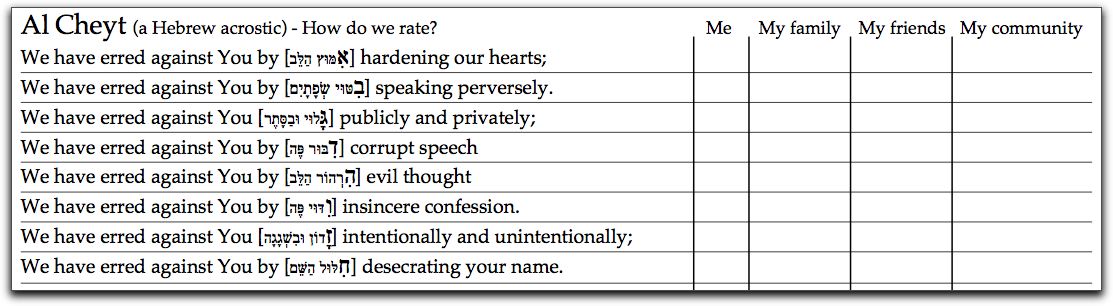
the “I’ve done that too” grid

Judah and Pin­chas learned while sit­ting among the col­leagues and stu­dents of R. Ila’i that we all share the same bound­aries of birth and death as well as many of the same shortcomings.

  • We have let friend­ships dete­ri­o­rate because we haven’t tried to bridge the gap of hurt. 
  • We have not helped when we could. 
  • We have expressed sor­row for our actions, but only when we felt it might pre­vent worse consequences. 
  • We have done things to oth­ers that we would not want done to ourselves.
the selichot "bingo" card

a por­tion of the (down­load­able) seli­chot “bin­go” card

While there are fre­quent­ly more than twelve steps to solv­ing prob­lems and the idea that we have the capa­bil­i­ty of solv­ing our prob­lems with­out “pro­fes­sion­al” help can be and has been ridiculed, there is a truth in the idea that we have with­in us the abil­i­ty (per­haps with some inter­ven­tion from oth­ers who know and under­stand us) to col­lect those mis-aimed arrows and cor­rect our aim.

full disclosure

I admit to hav­ing a per­son­al con­nec­tion to this idea. My father, who worked as a pro­fes­sion­al mar­riage and fam­i­ly coun­selor spent much of the last years of his career study­ing what he called “Peer Self Help Psy­chother­a­py Groups” (PSH­PGs we called them). He did his research (in the ear­ly and mid 1970s) long before the groups became com­mon in pop­u­lar cul­ture and lat­er renamed “Self-Help Mutu­al Aid Groups”. He believed that by de-com­mer­cial­iz­ing the ther­a­peu­tic rela­tion­ships these groups had as much, if not more effi­ca­cy than pro­fes­sion­al psy­chother­a­py. In addi­tion, Dad, though an athe­ist, thought he found some of the ori­gins of these groups in reli­gious move­ments. His work formed part of the ker­nal of the sto­ry of Betha­mi and R. Ila’i.

origins of the rabbinic yom kippur observance

How did it hap­pen that what was once exclu­sive­ly a sac­ri­fi­cial event in the Holy Tem­ple in Jerusalem become trans­formed into a gath­er­ing for the pub­lic con­fes­sion of wrong-doing? The sources only tell us that the trans­for­ma­tion occurred, as though the cur­tain went down on the Tem­ple and rose a moment lat­er dis­play­ing the syn­a­gogue and the litur­gy we now know.

Over the cen­turies we have added many “exer­cis­es” to the tasks of Yom Kip­pur. I believe, if we were to focus at least as much on their mean­ing as we do on the for­mal litur­gy, we might gain greater ful­fill­ment from the day. And so…

You can down­load a copy of the Seli­chot Home­work Sheet 2, make copies and dis­trib­ute them for your own use. This one exists only in PDF for­mat. In the next cou­ple of weeks, as we come near­er to Rosh haShan­nah and Yom Kip­pur I will present addi­tion­al (online) tools to help explore the mean­ing of the Al Ḥet.


Many lapel but­tons are nov­el­ty items, some­times pro­duced com­mer­cial­ly. So it is with this one. I don’t know the ori­gin of this but­ton, though it dates from the 1980s. I have nev­er worn it. (I prob­a­bly nev­er will wear it… I don’t iden­ti­fy with the val­ue it rep­re­sents.) As we approach the High Holy Days, our task is to come to terms with the issues that face us and not sim­ply kvetch.

kvetcher

kvetch­er

Date: 1980s
Size: 3.6
Pin Form: clasp
Print Method: cel­lu­loid
Text kvetch­er

your lapel buttons

Many peo­ple have lapel but­tons. They may be attached to a favorite hat or jack­et you no longer wear, or poked into a cork-board on your wall. If you have any lay­ing around that you do not feel emo­tion­al­ly attached to, please let me know. I pre­serve these for the Jew­ish peo­ple. At some point they will all go to an appro­pri­ate muse­um. You can see all the but­tons shared to date.

Posted in family, holidays, judaica, lapel buttons, who | Tagged , , , , , , , , , | Leave a comment