from prayerbook to leaflet
I have been involved in writing and distributing leaflets at least since 1966 when our family composed a leaflet [text] we distributed in front of our congregation’s Yom Kippur observance calling attention to the war in Vietnam.

The Hurvitz Family\‘s Yom Kippur Leaflet calling for an end to the war in Vietnam (1966)
During the late 1960s and early 1970s I must have put thousands of 8.5 x 11 (and a few 14) inch pieces of paper in the hands of passersby. For a while, when people would avoid me, knowing that I had something that might challenge their thinking, I would offer: “free scratch paper” as I extended my hand with the leaflet. This would catch their attention and cause them to take what I presented. When I and my colleagues became aware of all the paper we were using, we’d collect the sheets that got immediately tossed in the trash (if they were not crumpled or soiled) and use the flip side to print the next leaflet. I was self-conscious enough of this activity that I made a point of numbering and dating each leaflet.
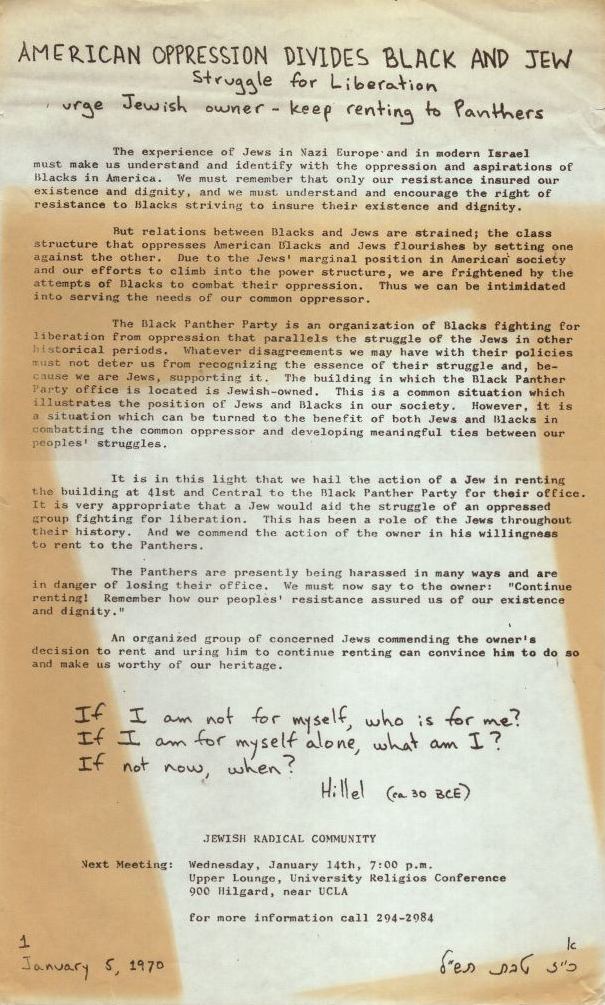
first leaflet of the Jewish Radical Community of Los Angeles: American Oppression Divides Black and Jew
When I worked as a “Part Time Program Coordinator of the Ombudsman Project of the Jewish Youth and Young Adults Council of the Jewish Federation-Council of Greater Los Angeles” (phew!) I distributed more literature. It was at that time that I prepared the leaflet I mentioned in a recent post (on April 10, 2010). I also distributed a monthly calendar of youth-oriented events and directory of Jewish organizations around Los Angeles. And, I prepared other items in attempts to attract interest to the excitement beginning to develop in the community. I had a few hundred of these bright yellow cards printed (sometime around 1970) and tacked them up on phone poles and bulletin boards around the Fairfax neighborhood as a “consciousness raising” tool.
Of course, in those days it did not rotate automatically (thank you Isaac Brynjegard-Bialik). I would put a thumb tack in the center and hope people would spin it to read it. The text:
The (green) text reads:
It is told: The summits of the mountains on whose gentle slopes Israel ben Eliezer lived are straight and steep. In hours of meditation he liked to climb these peaks and stay at the very top for a time. Once he was so deep in ecstasy, he failed to notice that he was at the edge of an abyss, and calmly lifted his feet to walk on. Instantly a neighboring mountain leaped to the spot, pressed itself close to the other and the Baal Shem pursued his way.
The (red) text says Survival Sacrifice (“Survival means Sacrifice” was the slogan of the UJA-Federation at the time) and has the (then) phone number and address of the Federation.
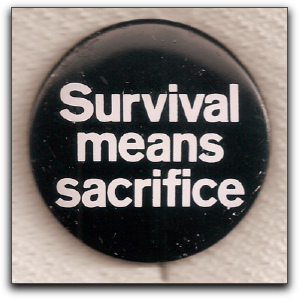
survival means sacrifice
from leaflet to web
Many years later, after a long hiatus from producing public materials for distribution… due to the not-uncommon activities of raising a family, Avigail asked if I could help her explain some of the issues surrounding Israel during the Second Intifada. in particular, following the Passover Massacre (which truly was a massacre) and the Battle of Jenin (which definitely was not a massacre) and the siege of the Church Of The Nativity as well as background information about Zionism and the Jewish connection to the Land of Israel.
And so I produced a series of 21 leaflets… distributed as PDF files, ready to download and print, and as text files available for modification, stored on my Web site. Colleagues turn to them regularly as an available resource for their courses and to offer their young people away at college.
Resources for Jewish College Students (and others)
twenty-one down-loadable leaflets
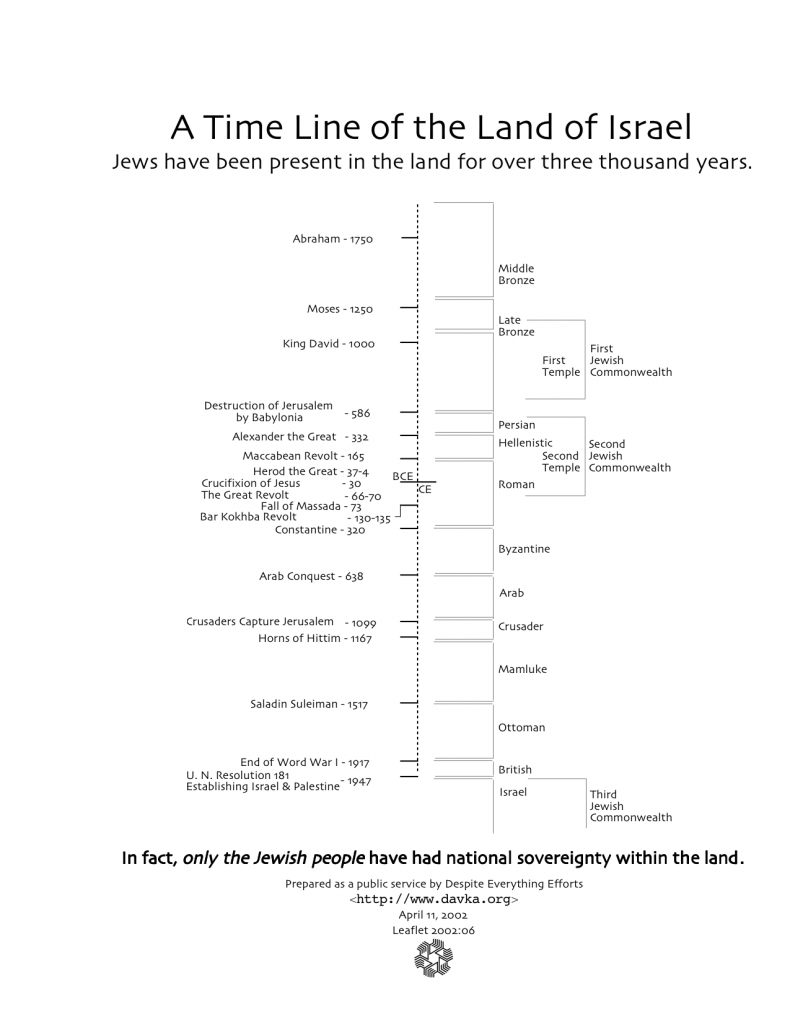
leaflet #6: a time line of the land of israel
from web to twitter
And now the world’s communications technologies have changed once again.
In Clay Shirky’s book Here Comes Everybody (A book about organizing without organizations.) he writes, engagingly, about the powerful communications technologies that we each have at our fingertips: our computers and cell phones. He describes a variety of society-transforming events that utilize some of these tools. I have entered the fray. I do what I can to master the techniques to communicate what is important to me and share that with others who I might never meet face to face. On May 17, I wrote about tweetiing #torah to the top as we gather @ sinai. We did not come close to the top ten “trending topics” (for the week, after all, we focused on only one day)! But you could sense the joy and excitement of Jews and others from all walks of life and religious backgrounds sharing thoughts about Torah, bringing Torah to the world.
Then, on Monday, May 31, 2010, a flotilla of ships organized to break the blockade of Gaza was intercepted by Israeli seamen. The resulting melee on one of those boats, the Mavi Marmara, brought on the international incident the organizers of the flotilla hoped to achieve.
I have not supported the blockade, nor (of course) the flotilla, nor the Israeli handling of the entire incident. I don’t know that I could have done better. But, given the viciousness of the anti-Israel invective that has ensued I have “taken to the airwaves”. I have sent out hundreds of tweets and called on my colleagues to join me.
One colleague wrote:
My only question is whether we, the American Jewish community, have any recognition at all that we have been — in the parlance of the street — sucker punched. And my second question, raised advisedly in this forum, is simply … where is the outrage from the religious leadership of the American Jews? Where is the outrage? Where?
I have been preparing a more thoughtful response to share at davka.org, but Rabbi X and colleague Y call me to action now.
Do you have a Twitter account? I have been posting, nearly incessantly. In a sense “leafletting” electronically, countering whatever lies I encounter. Many of our colleagues are doing the same, but not enough. Please join me. I presume you also saw the post (forwarded by colleague Y) by our Conservative colleague Rabbi Z. He supplies a number of “ready to release” “Tweets”. I’m sure you can think of more. We are being outmaneuvered by many who have set up fake (fraudulent?) Twitter accounts and sending hundreds of messages a minute. We may be outnumbered, but we can use what I presume is still ours: Seichel and Yiddishe Kop. I have (as I suggested in advance of Shavuot) scheduled some Tweets to go out while I am asleep. This enables my messages to be read by people in other parts of the world (they are awake and active while I am asleep). Some of these Tweets have been picked up and re-tweeted by people from India, Cyprus, Turkey.
There is much work to be done. You can also organize your congregants to serve as “tweet banks”. Much public opinion is shaped Online. Don’t abandon this medium.
fake twitter accounts
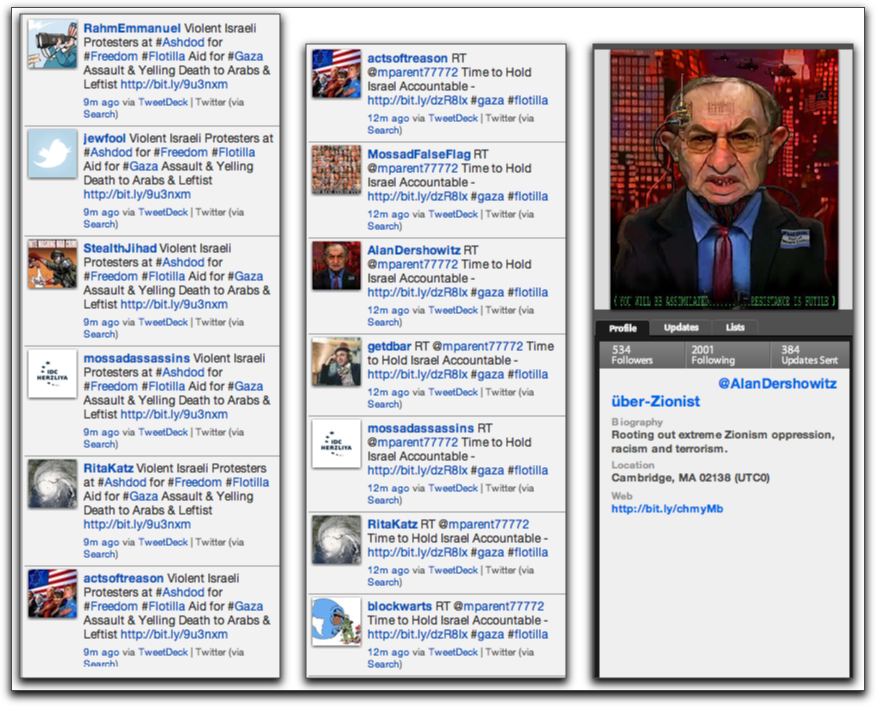
fake twitter accounts
hate and vitriol
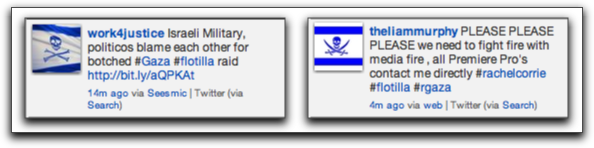
israel the pirate state
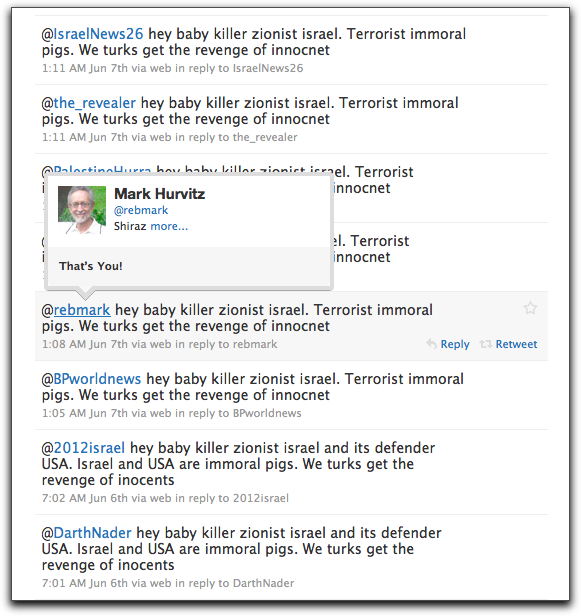
rebmark the baby killer
an exchange regarding the process
I have been standing at a “street corner” of hashtag #Flotilla on the internet superhighway passing out leaflets to all who go by. It is ugly out there. Most of the people I know drive by. A few wave hello. I go out at various times of the day and night (thank you FutureTweets!). This has allowed me to share my pile of leaflets with a wider range of people in different parts of the world. Monday (June 7, 2010), a young Reconstructionist rabbi, who I know happens to share most of my values wrote:
@rebmark How long will you be retweeting the same hasbarah tweets over and over?
To which I replied:
I stand on the street corner and offer leaflets to different people who walk by.
I felt that private email between the two of us was better than discussing this in public so I tracked down his address and wrote:
You know, as much as we don’t like the way this has been handled by Israel, there is a war going on. I believe we need to use whatever tools we have available to reach as many people possible. We need to get our perspective out there and have it spread. Some tweeters have called for our death (yes, you and me) with rather unpleasant words. I’m a pretty nice guy. I support Hazon and bike riding, you know, all the right things. But I won’t stand by and let those who will twist the world against me to their own purposes (even using fraudulent Twitter accounts). If that means that I stand on the street passing out the same (and new leaflets) so be it. I seem to continue to get new readers. Consider it a form of “carpet bombing”.
I offered a couple of prepared tweets that were absolutely fresh and I had not sent.
- Reuters brings Fauxtography to the #Gaza #Flotilla #Israel #Palestine http://bit.ly/gzfltll14
- RT @BoBi47: Why is the U.N. not investigating “humanitarian #flotilla” passenger list & method of boarding prior to departing for #Gaza?
He responded, proving Peter Beinart’s point:
But I’m also a left Zionist, and I don’t think it’s my responsibility to justify every stupid decision made by bad Israeli governments.
He raised a good point:
- rebmark And you think RT’ing RW nonsense like this is going to make ppl like us better?
- If you want to claim #flotilla thing justified, gey gezunt. I don’t think claiming Palestine is southern Syria is going to make the case.
And we ended with my telling him that I do not claim it was justified:
Do you see me write that? I write to counter ugly anti-Israel/Zionist/Jewish comments & force thought.
He made valid arguments, but, I believe we have to do whatever we can to cause “cognitive dissonance”. Silence is assent. And, as my brother, Jay, writes:
What would you consider to be legitimate means for Israel to defend herself?
electronic leaflets
I have prepared a number of 140-character-or-less messages.
You might find them of some value. I know from my own experience that many of them have caused passersby in the “Twittersphere” to think twice… if not more. They are sorted into four separate groups. Only the last two groups have a particular sequence. Because the last two groups should be read in sequence I generally send them out using FutureTweets at about 10–30 second intervals.
group one (general posts):
• I don’t agree with all that she writes, but she argues it clearly and well. http://bit.ly/cGYGOH #Gaza #Flotilla #Israel
• All Americans would defend actions of IDF if those beaten wr their own sons/brothers/husbands/fathers. http://bit.ly/cGYGOH #Gaza #Flotilla
• Police inspecting car f/ drugs… surrounded by gng & beaten w/ pipes: right > use gun, depend on partner http://bit.ly/cGYGOH #Gaza #Flotilla
• More Palestinians Homes Demolished http://bit.ly/9Mle6n #Hamas #Gaza #Palestine #Israel
• Final Abandonment of #Gaza — Radicals & terrorists have far more patience than international community. #Flotilla http://bit.ly/gzfltll16
• RT @fmaidment: #Turkey divided over #flotilla violence (@redstate) http://bit.ly/aTxwrf (@TMRNetwork) http://bit.ly/9Ws8Gx #Gaza #Israel
• Deep fear, traumatic residue: blownup buses, rockets, pounded into rhythm of growing #Iran threat. http://bit.ly/gzfltll15 #Gaza #Flotilla
• Reuters brings Fauxtography to the #Gaza #Flotilla #Israel #Palestine http://bit.ly/gzfltll14
• RT @BoBi47: Why is the U.N. not investigating “humanitarian #flotilla” passenger list & method of boarding prior to departing for #Gaza?
• #Turkey responsible for #Gaza #Flotilla crisis, not #Israel http://tinyurl.com/39ql5ss
• Jonathon Narvey: Free oppressed #Kurdistan, join the aid #flotilla against criminal #Turkey regime http://tinyurl.com/23fz972 #Israel #Gaza
• #Turkey ’s outrage over #flotilla violence is misdirected http://tinyurl.com/2uwarlu #Kurdistan #Armenian #Genocide #Israel #Palestine #Gaza
• PM #Erdogan wants to visit #Gaza, how would he feel about PM #Netanyahu visiting #Kurds? #Turkey #Israel
• RT @shahriar: #flotilla captain who defied naval directives is responsible > injuries+death of aid workers & Israeli soldiers. #Gaza #Israel
• #Flotilla cnfrms profound, nearly unquestioned prob: intellectual, moral #siege / #Israel by “Respectable World”. http://bit.ly/gzfltll6
• Youtube blocked in #Turkey. Additions made for disabling accessibility of Youtube via DNSs http://bit.ly/gzfltll5 #Gaza #Israel #Flotilla
• RT @mdp4202: Rachel Corrie Proves #Israel Doesn‘t Need Commandos or Shootings #Gaza #Flotilla \ NO! 1st 5 boats prove that!
• Sail Internet #flotilla > #Turkey w/ wireless routers provide free Internet beyond territorial H2O http://bit.ly/gzfltll5 #Gaza #Israel
• #Turkey Web developer: clients’ sites crawl cause they have google analytics. must be joke? http://bit.ly/gzfltll5 #Gaza #Israel #Flotilla
• don’t like blockade, I admit #Gaza is under siege, but humanitarian crisis? http://www.rootsclub.ps/ #Israel #Palestine #flotilla
• ‘Peace convoy’? This was an Islamist terror ambush http://bit.ly/gzfltll7 #Gaza #Flotilla #Israel
• RT @jstrevino: Remember when #flotilla people expressed deep concern for humanity, were angry over Coptic persecution in #Egypt? No? #Gaza
• #Hamas, #Israel, & #Gaza #flotilla: 7 facts you need to know http://bit.ly/gzfltll1 pls rt
• How would #Turkey react to a boatload from #Israel attempting to land aid to the PKK? http://bit.ly/gzfltll7 #Gaza #Flotilla
• Why is #Palestine ‘ a second #Cyprus ’ for Turks? http://bit.ly/gzfltll2 #Gaza #Flotilla #Israel #Turkey
• #Flotilla “shahids” (martyrs) sail frm N #Cyprus, UN calls occupied. Tell 1,000,000 #Armenians re #Turkish justice http://bit.ly/aWpTUk
• Possible? #Turkey & #Iran engineered incident to keep UNSC busy as new sanctions on Iran looms. #Gaza #Flotilla #Israel #Palestine
• RT @iRevolt: Turkey never forgive Israel (15,000 mourn @ funeral of 8 dead #flotilla) http://bit.ly/dhB3a5 & #Armenia? http://bit.ly/aWpTUk
• Just how hungry is #Gaza? http://bit.ly/gzfltll9 #Israel #Flotilla
• #Turkey Erdogan bears responsibility in #flotilla fiasco (Washington Post) http://bit.ly/gzfltll10 #Gaza #Israel #Palestine
• RT @thezub: Head of IHH, 1 of so-called “humanitarian” orgs that organized “Freedom Flotilla” at Hamas rally in 2009. http://bit.ly/9nLUD9
• #Hamas prohibits visit Gilad Shalit, include Red Cross, violate Geneva Convention & intrntnl legal requirements #Gaza http://bit.ly/gldshlt
• #TURKEY has BLOOD on its hands, NOT #Israel http://tinyurl.com/255ksq2 #FreedomFlotilla #Flotilla #Gaza
• #HAMAS responsible 4 suffering of #Palestine & #Israel : RACIST CHARTER http://bit.ly/d2ta73 #FreedomFlotilla #Flotilla #Gaza
• B4 departure: Activists chant INTIFADA songs, praise MARTYRDOM http://tinyurl.com/2bkseol #FreedomFlotilla #Flotilla #Gaza
• RT @Uplication: @dogdazed Nobody tried to kill people on ship. Other ships where no lynch attempt was made on soldiers are proof #Flotilla
• RT @dominiofeminino: Where are #Israel enemies? 26 ppl To be executed in Tehran in 48 hrs http://tinyurl.com/3ynpa42 #Iran #Gaza #Flotilla
• Eyeless in #Gaza? Maybe you, not him… http://bit.ly/gzfltll12 #FreedomFlotilla #Flotilla #Israel #Hamas
• World is tired… these troublesome Jews, refusing every invitation > national suicide. http://bit.ly/gzfltll13 #Gaza #Flotilla #Israel #Hamas
• http://www.arabianawareness.com/ refuses to recognize a 2‑State solution. See image on home page #Gaza #Israel #Palestine #Flotilla
• war crimes WERE committed by those who organized & sponsored #flotilla http://tinyurl.com/327qp9s #Israel #Gaza
• RT @Martin_Kramer: Rasmussen: 49% of U.S. Voters Blame Activists > Flotilla Deaths, 19% Blame Israel, Weekly http://goo.gl/fb/d9SNq
group two (israel and palestine)
• Fall of Ottoman Emp in World War I Britain/France occupy Kurdistan. Now 30 mlln Kurds occupied by Turkey Syria Iraq & Iran Who complains?
• From 1948 through 1967 #Egypt occupied #Gaza Who complained? #Flotilla #Israel
• #Palestine = Syria, nvr separate frm… connected / national/religious/lngstc/natural/economic/geographic bonds. http://bit.ly/bINUlQ Muhsein
• #Palestine ? Resolve: 1st Congress: Muslim-Christian Assctns; Jerusalem, Feb, 1919 meet choose reps > Paris Peace Conf. http://bit.ly/bINUlQ
• No such country! #Palestine = term Zionists invented! Is no Palestine in Bible. Our country > centuries part/ Syria. Auni Bey Abdul-Hadi
• “There is no such thing as ‘Palestine’ in history, absolutely not.” Arab-Amer hstrn, Princeton U Prof Philip Hitti 1946 http://bit.ly/duZbVC
• #Palestine part/ Province of Syria… politically, Arabs of Palestine not independent in sense of forming separate political entity… #Zionism
• Arab Higher Committee representative to the United Nations at the General Assembly, May, 1947 http://bit.ly/a3P5zV #Palestine #Zionism
• Common knowledge that #Palestine = nothing but southern Syria. Ahmed Shuqeiri (1ce chairman PLO) > Security Council http://bit.ly/a3P5zV
• From 1948 — 1967 there were no Israelis in the “West Bank” or #Gaza. Arab states called all of #Israel “Occupied #Palestine”. #Zionism
• Who complained, call: West Bank “Occupied Territories” during 19 yrs after #Israel War/Independence 1948 as #Egypt occupied #Gaza?
• Who complained, call: West Bank “Occupied Territories” during 19 yrs after #Israel War/Independence 1948 as #Jordan occupied West Bank?
• Palestinian nationalism now real, #Palestine people must recognize right of Jewish people to national mvmnt: #Zionism. http://bit.ly/whtznsm
group three (israel and the land)
based on leaflet #11 of Resources for Jewish College Students
• Israel and the Land (some highlights) http://bit.ly/whtznsm [ #Gaza #Palestine #Flotilla #Zionism #Israel ]
• 1020–1000 BC Saul becomes king of Hebrew tribes I Samuel 9:15–27, 10:1 http://bit.ly/whtznsm [ #Gaza #Palestine #Flotilla #Zionism #Israel ]
• 1000–961 BC Reign of David II Samuel 5: 1–5 http://bit.ly/whtznsm [ #Gaza #Palestine #Flotilla #Zionism #Israel ]
• 961–922 BC Reign of Solomon I Kings 1: 32–40 http://bit.ly/whtznsm [ #Gaza #Palestine #Flotilla #Zionism #Israel ]
• 922 BC Kingdom of Israel div> 2 kingdoms Israel/Judah I Kings 11:29–43 http://bit.ly/whtznsm [ #Gaza #Palestine #Flotilla #Zionism #Israel ]
• 853 BC King Ahab fights the Arameans http://bit.ly/whtznsm [ #Gaza #Palestine #Flotilla #Zionism #Israel ]
• 722 BC Assyria conquers Israel II Kings 17:1–6 http://bit.ly/whtznsm [ #Gaza #Palestine #Flotilla #Zionism #Israel ]
• 701 BC King Hezekiah digs Siloam tunnl II Kings 20:20, Isaiah 22:10–11 http://bit.ly/whtznsm [ #Gaza #Palestine #Flotilla #Zionism #Israel ]
• 586 BC Babylon conquers Judah II Kings 25:1–12 http://bit.ly/whtznsm [ #Gaza #Palestine #Flotilla #Zionism #Israel ]
• 539 BC Exiles return from Babylon Ezra 1:1–11 http://bit.ly/whtznsm [ #Gaza #Palestine #Flotilla #Zionism #Israel ]
• 516 BC Dedication of Second Temple Ezra 4:23–24, 5:1–5 http://bit.ly/whtznsm [ #Gaza #Palestine #Flotilla #Zionism #Israel ]
• 332 BC Conquest of Jerusalem by Alexander the Great http://bit.ly/whtznsm [ #Gaza #Palestine #Flotilla #Zionism #Israel ]
• 250 BC The Greek translation of the Bible is published http://bit.ly/whtznsm [ #Gaza #Palestine #Flotilla #Zionism #Israel ]
• 168–165 BC Maccabean Revolt http://bit.ly/whtznsm [ #Gaza #Palestine #Flotilla #Zionism #Israel ]
• 63 BC Roman conquest of Jerusalem (through 313 AD) http://bit.ly/whtznsm [ #Gaza #Palestine #Flotilla #Zionism #Israel ]
• 37–4 BC Reign of Herod the Great http://bit.ly/whtznsm [ #Gaza #Palestine #Flotilla #Zionism #Israel ]
• 19⁄20 BC Herod rebuilds Temple in Jerusalem http://bit.ly/whtznsm [ #Gaza #Palestine #Flotilla #Zionism #Israel ]
• 66–73 Jewish rebellions against Romans http://bit.ly/whtznsm [ #Gaza #Palestine #Flotilla #Zionism #Israel ]
• 70 The Destruction of the Temple in Jerusalem http://bit.ly/whtznsm [ #Gaza #Palestine #Flotilla #Zionism #Israel ]
• 73 Fall of Masada http://bit.ly/whtznsm [ #Gaza #Palestine #Flotilla #Zionism #Israel ]
• 135 Bar Kokhba Rebel (Romans destroy remnants > Jewish sovereignty) http://bit.ly/whtznsm [ #Gaza #Palestine #Flotilla #Zionism #Israel ]
• 200 Codification of Jewish oral law (Mishnah) completed in Yavneh http://bit.ly/whtznsm [ #Gaza #Palestine #Flotilla #Zionism #Israel ]
• 313–616 Byzantine Rule http://bit.ly/whtznsm [ #Gaza #Palestine #Flotilla #Zionism #Israel ]
• 390 Commentary on the Mishnah (Jerusalem Talmud) completed http://bit.ly/whtznsm [ #Gaza #Palestine #Flotilla #Zionism #Israel ]
• 614 Persian Invasion http://bit.ly/whtznsm [ #Gaza #Palestine #Flotilla #Zionism #Israel ]
• 636‑1099 Arab Rule http://bit.ly/whtznsm [ #Gaza #Palestine #Flotilla #Zionism #Israel ]
• 691 On site of First/Second Temples in Jerusalem, Dome of Rock built http://bit.ly/whtznsm [ #Gaza #Palestine #Flotilla #Zionism #Israel ]
• 1099–1291 Crusader Domination (Latin Kingdom of Jerusalem) http://bit.ly/whtznsm [ #Gaza #Palestine #Flotilla #Zionism #Israel ]
• 1291–1516 Mamluk Rule http://bit.ly/whtznsm [ #Gaza #Palestine #Flotilla #Zionism #Israel ]
• 1517–1917 Ottoman Rule http://bit.ly/whtznsm [ #Gaza #Palestine #Flotilla #Zionism #Israel ]
• 1564 Code of Jewish law (Shulhan Arukh) published http://bit.ly/whtznsm [ #Gaza #Palestine #Flotilla #Zionism #Israel ]
• 1577 Hebrew printing started in Safed. 1st press in Ottoman Empire. http://bit.ly/whtznsm [ #Gaza #Palestine #Flotilla #Zionism #Israel ]
• 1860 1st neighborhood (Mishkenot Sha’ananim) built out Jerusalem walls http://bit.ly/whtznsm [ #Gaza #Palestine #Flotilla #Zionism #Israel ]
• 1882–1903 1st large-scale immigration mainly from Russia http://bit.ly/whtznsm [ #Gaza #Palestine #Flotilla #Zionism #Israel ]
• 1904–1914 2nd large-scale immigration mainly from Russia and Poland http://bit.ly/whtznsm [ #Gaza #Palestine #Flotilla #Zionism #Israel ]
• 1909 1st Kibbutz (Degania) & 1st modern Jewish city (Tel Aviv) founded http://bit.ly/whtznsm [ #Gaza #Palestine #Flotilla #Zionism #Israel ]
• 1918–1948 British Rule http://bit.ly/whtznsm [ #Gaza #Palestine #Flotilla #Zionism #Israel ]
• 1948 State of Israel established (& Palestinian State)> United Nations http://bit.ly/whtznsm [ #Gaza #Palestine #Flotilla #Zionism #Israel ]
group four (what is zionism)
based on leaflet #18 of Resources for Jewish College Students
• What is #Zionism? [ #Gaza #Palestine #Flotilla #Israel ] http://bit.ly/whtznsm
• #Zionism is the national liberation movement of the #Jewish people. [ #Gaza #Palestine #Flotilla #Israel ]
• You may have always thought Jews were a religion. They are that, and more. [ #Gaza #Palestine #Flotilla #Zionism #Israel ]
• Through long world history many national states arose & fell. [ #Gaza #Palestine #Flotilla #Zionism #Israel ]
• Among these: great empires: Sumeria, Assyria, Babylonia, Egypt, Greece, Persia and Rome. [ #Gaza #Palestine #Flotilla #Zionism #Israel ]
• Smaller states also existed. Among them: Jebusites, Moabites, Ammonites & Judahites. [ #Gaza #Palestine #Flotilla #Zionism #Israel ]
• Back then when 1 defeated another, defeated people & its identity disappeared from history. [ #Gaza #Palestine #Flotilla #Zionism #Israel ]
• Rare instances this didn’t occur & group continued to play a role in contemporary affairs. [ #Gaza #Palestine #Flotilla #Zionism #Israel ]
• You will not meet a Jebusite, Moabite, nor an Ammonite in the mall… [ #Gaza #Palestine #Flotilla #Zionism #Israel ]
• …even though people now live in the area long-ago known as Jebus, Moab and Ammon. [ #Gaza #Palestine #Flotilla #Zionism #Israel ]
• You will meet descendants the ancient Babylonians, known today as Chaldeans, [ #Gaza #Palestine #Flotilla #Zionism #Israel ]
• Persians destroyed Chaldeans’ empire & they never again held political power in their land. [ #Gaza #Palestine #Flotilla #Zionism #Israel ]
• Chaldeans live in Detroit, San Diego, & in their native land now known as Iraq. [ #Gaza #Palestine #Flotilla #Zionism #Israel ]
• Can also meet descendants of ancient Israelites & cousins Judahites, “Jews” (for short) [ #Gaza #Palestine #Flotilla #Zionism #Israel ]
• Similar to American people who carry ideal of “life, liberty, & pursuit of happiness,” [ #Gaza #Palestine #Flotilla #Zionism #Israel ]
• Jewish people carry set of ideas through long history, these ideas called “Judaism”. [ #Gaza #Palestine #Flotilla #Zionism #Israel ]
• This is why Jews are thought of as being a religion. [ #Gaza #Palestine #Flotilla #Zionism #Israel ]
• Nearly 2000 years ago, while suffering under oppressive Roman Empire’s occupation [ #Gaza #Palestine #Flotilla #Zionism #Israel ]
• Jews rose up & fought for liberation. Following 2 major uprisings, spanning generations… [ #Gaza #Palestine #Flotilla #Zionism #Israel ]
• Rome destroyed nearly all vestiges of Judaeans’ (Jews’) presence in their land. [ #Gaza #Palestine #Flotilla #Zionism #Israel ]
• Western retaining wall of their Temple still stands as a reminder of their sovereignty. [ #Gaza #Palestine #Flotilla #Zionism #Israel ]
• Ruins of meeting houses, known as synagogues are found throughout the land. [ #Gaza #Palestine #Flotilla #Zionism #Israel ]
• During the following two millennia, Jews lived among other peoples. [ #Gaza #Palestine #Flotilla #Zionism #Israel ]
• Jews with others’ sorrows & shared in their successes; often attacked for being “outsider”. [ #Gaza #Palestine #Flotilla #Zionism #Israel ]
• In the late 1800s Jews all over the world began returning to the land of their origin. [ #Gaza #Palestine #Flotilla #Zionism #Israel ]
• They organized to make this possible. Jews raised money and purchased land. [ #Gaza #Palestine #Flotilla #Zionism #Israel ]
• Jews trained selves to farm & work in industry; established infrastructure of new society. [ #Gaza #Palestine #Flotilla #Zionism #Israel ]
• This effort is called Zionism. The fruit of this effort is Israel. [ #Gaza #Palestine #Flotilla #Zionism #Israel ]
• Jews: every color/race, every corner of world are welcomed to return rebuild this society… [ #Gaza #Palestine #Flotilla #Zionism #Israel ]
• The modern State of Israel. Zionism is not racism. [ #Gaza #Palestine #Flotilla #Zionism #Israel ]
• What is #Zionism? [ #Gaza #Palestine #Flotilla #Israel ] http://bit.ly/whtznsm
Both the button above and this one I feature here date from approximately the same period, the late 1960s early 1970s. While I know that I have sacrificed a variety of things for our survival, I prefer, at this moment to stress my concern about stopping Arab terror in its various manifestations. When the button was produced, we thought in terms of “Arab” terror organized by secularists. Now we are more likely to think in terms of “Muslim” terror. My how the world shifts in subtle ways.
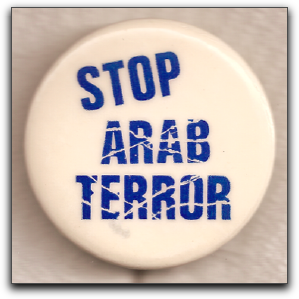
stop arab terror
| Date: | 1974 |
| Size: | 3.8 |
| Pin Form: | straight |
| Print Method: | celluloid |
| Text | STOP ARAB TERROR |
your lapel buttons
Many people have lapel buttons. They may be attached to a favorite hat or jacket you no longer wear, or poked into a cork-board on your wall. If you have any laying around that you do not feel emotionally attached to, please let me know. I preserve these for the Jewish people. At some point they will all go to an appropriate museum. You can see all the buttons shared to date.