tweet #torah to the top as we gather @ sinai
I have been “on” (or using) Twitter since January 2009. I don’t use it much socially, but rather educationally and politically. I don’t share where I am, how I’m feeling and what I’m eating. I share thoughts about #Torah, #Israel, #Palestine, #Gaza, #Iran, #Auschwitz, #Shoa, #Holocaust, #Jewish, #Exodus, #Sukkot, #Rabbi, #Shabbat, #Lapelbutton (!? search for it, you’ll find nothing.). You get the idea.
torah on twitter
When I first started exploring how to use Twitter to teach Torah I had contact with R. Phyllis Sommer (@imabima). We shared lists of other rabbis we knew who were using Twitter. At that time, I also learned about a blog post by Reconstructionist Rabbi Shai Gluskin on a site sponsored by the Jewish Publication Society. R. Gluskin wrote about the idea and introduced the project of tweeting #Torah on erev Shavuot (in the comments) on his own personal blog. Others who wrote about the possibilities of sharing (dare I write teaching) Torah on Twitter in 2009 include Drew Kaplan, who at the time was a YU rabbinic student in New York, and, though he has not shared anything in many months, Adam Simon who “tweets” as “TwitTorah”
tweet the exodus
Shortly before Pesach this year a group of colleagues decided to Tweet The Exodus. They each took roles and sent out regular tweets. As of this writing, the story is still available. During the two week period from March 16 to March 29, at its peak there were over 1400 followers. People all over the world receiving the story of the Exodus from slavery in Egypt 140 characters at a time. What a fabulous was to teach Torah!
to my fellow huc-jir alumni I wrote…
…that I had seen a number of us had, once again, been counting the Omer on our Facebook pages. Some were also doing so on Twitter. I enjoy seeing this counting and all the different ways we do it. There seemed to be a momentum building as we neared the moment of Revelation.
Last year, following the dictum of Hillel in Pirke Avot: “ומקרבן לתורה bringing them close to the Torah”, there was an attempt to bring Torah to as many people as possible on the day before Shavuot, using Twitter. As expressed last year by Reconstructionist Rabbi Shai Gluskin (136 characters):
Are you in? A 49th day of omer prep for Shavuot #Torah fest. Goal: get many tweeting Torah and see #Torah trend in top 10 the whole day.
Last year we were able to raise #Torah to the mid-30s of the most tweeted topics. I suggested we give it our best again this year.
The “day” of May 18, 2010 is “erev” Shavuot. I suggested that we each prepare as many 133-character Torah lessons as we could to “release” on that day. To those who may have been sharing #Torah Tweets through the year, I suggested that Torah does not go bad. They should feel free to “recycle” those thoughts.
I think this is a great way to encourage awareness of Torah. I’m sure we each have many simple “Torah thoughts” that can be expressed in 133 characters. (The limit is 133 to leave room for the final space and #Torah, which is 7 more characters.)
I suggested that we each prepare a number of “tweets” in advance in a text file and simply copy, then paste them into our preferred Twitter tool about once or so an hour (depending on your “capabilities” (schedule, etc.)). For those who use Twitter with their congregations, I suggested that congregants, too, can join in… either with their own thoughts, or questions, about #Torah. We could encourage everyone to become involved in thinking Torah as a lead-in to Shavuot.
what’s with shavuot and torah?
The TaNaKh says nothing about when Torah was given to the Jewish people. The association of the two occurs in early Rabbinic times. It is certain that enough Jews believed that Torah was given at Shavuot for the earliest Christians to develop a festival that mimics the meaning, if not the activity of the holiday. seven weeks time between Pesach and Shavuot is a time of concern as the next year’s grain harvests are collected. Will there be enough to last through the year or not? By the time the seven week period has ended, all the grain would have been collected and “the word” would be in. This “receiving of the word” about whether or not it would be a fat or a lean year likely became associated with other ideas related to “the word” being given.
Christians observe a feast related to “the word” being given as well. Theirs occurs fifty days following Easter (“penta” = 5, as in pentagon, pentagram, etc. Pentecost is based on the Ancient Greek πεντηκοστή [ἡμέρα], pentekostē [hēmera], “the fiftieth [day]”. According to the Book of Acts (2:1–4):
On the day of Pentecost [that is Shavuot… 50 days after the first day of Pesach] all the Lord’s followers were together in one place. Suddenly there was a noise from heaven like the sound of a mighty wind. It filled the house where they were meeting. Then they saw what looked like fiery tongues moving in all directions, and a tongue came and settled on each person there. The Holy Spirit took control of everyone, and they began speaking whatever languages the Spirit let them speak.
do you have the word?
I don’t believe that I have “THE WORD”
My father warned me against this kind of thinking long ago when he wrote his song The Word.
Nonetheless, I think there are ways in which we are “spoken to”. There are moments in which things are “revealed to us”. There are instances when “the infinite” seemingly reaches out and touches “the finite”.
We can, and should, celebrate these events. In the experience of the Jewish people the time when this process began is associated with the giving of Torah to Moses on Mount Sinai.
51 tweets to explain “revelation”
I have prepared nearly 200 little messages to share on Twitter beginning early on Tuesday morning May 18, 2010. These continue through the late afternoon. Beginning at 1:00 PM I will be sending through Twitter a series of 51 little tweets on the subject of “revelation”
What is “revelation”? Some thoughts follow.
- #Torah (1 — I’m not a mathematician, but, there is a metaphor in here that helps, as we discuss “infinite” a bit.
- #Torah (2 — The string “a”: 0 1 2 3 4 5 6 7 8 9 to infinity has how many numbers?
- #Torah (3 — The string “b”: 0 3 6 9 12 15 18 21 24 27 to infinity has how many numbers?
- #Torah (4 — The string “c”: 0 4 8 12 16 20 24 28 32 36 to infinity has how many numbers?
- #Torah (5 — Are more numbers in string “a” than “b” or “c”? of course not. Yet strings “b” and “c” are “in” “a”, & some of “c” is in “b”.
- #Torah (6 — We are finite.
…and so on
I am not a philosopher. My attempt to express this idea may be pedestrian, but I have found that many people with whom I have shared it appreciate the thought.
Some time in the early 1990s Torah Aura Productions, a Jewish educational publishing company in Los Angeles (they have a cute phone number: (800) BE-Torah) produced a book and curriculum called Being Torah. I always liked the concept, especially because it came with a lapel button. But, consider that the best way to receive Torah is to give it, and the best way to give it is to live it. I’ve been wearing the button for the past few days in anticipation of Shavuot.
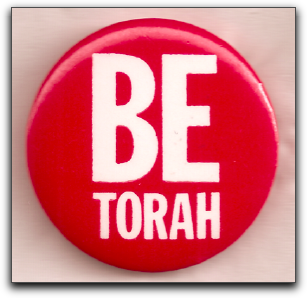
Be Torah
| Date: | 1990s |
| Size: | 3.1 |
| Pin Form: | straight |
| Print Method: | celluloid |
| Text | BE TORAH |
your lapel buttons
Many people have lapel buttons. They may be attached to a favorite hat or jacket you no longer wear, or poked into a cork-board on your wall. If you have any laying around that you do not feel emotionally attached to, please let me know. I preserve these for the Jewish people. At some point they will all go to an appropriate museum. You can see all the buttons shared to date.