[Originally published November 26, 2011; updated to fix broken links and formatting October 22, 2020.]
dark mornings
As the northern hemisphere moves deeper into winter with less light for each day, our mornings begin near dawn. This is a beautiful time of beginnings and promise. While the sounds we hear each morning are not those of birds chirping and children learning, but the clanking of men at work, even these call out for blessings. I recall a favorite melody Rabbi Neil Comess-Daniels, a classmate, composed for the beginning of ברוך שאמר (baruch she’amar) the first of the פסוקי דזמרא (pesukei dezimra) recited at the beginning of the “morning cheers”. I rarely hear anyone sing it, though I believe it expresses the text beautifully.
written or spoken
This came to mind when I learned from Avigail that she is involved with a project called “Shaharit: A Think-tank for new Israeli Politics” and its English language podcast “The Promised Podcast” …being a podcast for anyone who wants to understand Israel beyond the headlines. Or, as they write:
Finally, after thousands of years and so many desert sojourns, it’s here! Gripping discussion and perspectives on Israeli politics and culture. You’ll wonder how you ever lived without it.
The Promised Podcast on Apple Podcasts An inside view of how Israel can warm your heart and make your blood boil. It's a show by a journalist, a professor and an NGO professional who live in and love Israel even though it drives them crazy, and who each week discuss the latest in Israeli politics, culture, and society.
Podcasts are not my medium of choice. My BA was in music and I’m rather attuned to sound, but I did not have an iPod until I needed a new phone in February of 2011. I had my hearing checked in late October, learning that my hearing is quite fine (for my age). While I’m beginning to lose those upper registers, I’m nowhere near needing an “aid”. I relish the “Silence” (which I owned for many years).
I appreciate Oscar Wilde’s comment in “The Critic as Artist”:
Since the introduction of printing, there has been a tendency in literature to appeal more and more to the eye, and less and less to the ear which is really the sense which, from the standpoint of pure art, it should seek to please, and by whose canons of pleasure it should abide always.
Nonetheless, I’m a text guy. I don’t listen for my information, I read. Even though I prefer to read, one of the rare pluses of needing to drive while living in Southern California was the time I would spend in the car listening to various news and information programs. Otherwise, when I sit at my desk with my computer in front of me (which is the vast majority of my time), I read and write. If I’m doing chores in the apartment, or cooking, and I’m alone, I will sometimes turn on my iTunes, set the music library to randomly select anything from the (currently) 14,771 “songs” amounting to 76.7 days, or 75.17 GB of files. I like to start out the selection with something from the 1,347 “songs” amounting to 36.4 days that I’ve not yet heard since adding them to the library. [Yes, that’s an odd ratio. And a lot of listening yet to do.]
walking and talking
However, there are times when I will go for a walk alone. Most of these walks are within a 7‑block radius from the apartment: to the library, the cobbler, the vintner, the cleaner, one or another market, the post office, (not the butcher, the baker, nor the candlestick-maker); the usual neighborhood errands. These jaunts are too short to merit plugging the earbuds into the phone and listening to anything other than the city’s sounds. Other times I will walk for a mile or more. These longer walks might be for exercise/pleasure or for an errand beyond the immediate ‘hood. In such a case, I will plug in, and, if the city streets are quiet enough I can hear someone talking on a podcast.
It was on such a walk one morning in late October when I was finally able to sample the “Promised” podcast. The session I happened upon was the one recorded immediately following the release of Gilad Shalit. The initial segment had Gershon Baskin as it’s guest. Aside from his discussion of the role he played in the release of Shalit, I learned that he and the three regular discussants on the podcast are all “graduates” of Young Judaea. I suddenly felt a special kinship, as I was also deeply touched by my experience in Young Judaea.
some movements end in a whimper, others due to success
Both the internationalist Jewish left that consisted of first-generation Americans (and their children) and the Zionist youth movements that helped create the State of Israel had thousands of adherents in the early and middle 20th century. They are nearly non-existent today at the beginning of the 21st century. Both of these movements (though antagonistic towards each other) added a vibrancy to American Jewish life. What happened? I am not a historian, but I know from personal experience that most of the children of the immigrant members of YKUF rose out of the working class, became professionals and, while they maintained a fondness for Yiddish, were not able to create Yiddish speakers and readers of their children (the third-generation Americans). Among the Zionists on the other hand, they were often so successful in imparting their ideology (as was the case wtih the Habonim ken (“nest” as in group of youngsters) in Los Angeles) that the entire leadership made Aliyah leaving those behind to struggle, often unable to maintain the continuity of the group.
While I had grown up in a Yiddishist/Internationalist home, my parents introduced me to Zionism in my early teens (I think for the sake of using the local Habonim summer camp). I continued my involvement during the year, accepting the nationalist argument. It was in the Habonim Makelah (chorus) that I met Bonia Shur. But, when the reigning hadracha (leadership) made aliyah and the social fabric of our ken dissolved, I looked for another group. Our family friends in the Bay Area had long been involved in Young Judaea, but its non-political nature had not been attractive. Nonetheless, I contacted the local group and attended some gatherings. The Young Judaea group in Los Angeles in the early ’60s was much more intellectually involved than was Habonim. I don’t remember ever participating in a discussion of Jewish thought in Habonim. But at regular meetings at the home of our Young Judaea madrich (he must have been in his early 30s, with a young family; he lived in a duplex on 6th St. between Fairfax and La Cienega) we enjoyed discussions of the work of Martin Buber and A. J. Heschel.
In the process of becoming more active in Young Judaea, I learned of it’s Israel Year Course program. Our family friends’ daughter would be participating in it the year she graduated high school, 1964–65, the same year that I would graduate. This seemed like an amazing opportunity not to pass up. While now Year Course is marketed as a gap year program, in the mid ’60s (and probably for many years later), only someone who had been active in the movement could participate. Because I was a newcomer (I’d never been to any Young Judaea summer camp, and had been involved in the local group only a year), I needed to “prove” my acceptability by attending the “advanced” program of the national camp Tel Yehudah in Barryville, NY along the Delaware River.
Though I was born in Springfield, MA, and spent a couple of years in Akron, OH, I don’t think I had been east of San Bernardino, CA since the age of four. I flew east on my own. I don’t remember if I was met at JFK by someone from Young Judaea or by my uncle who lived on Long Island. Be that as it may, I spent a great time at camp “Machaneh Avodah” (work camp), where aside from studying Zionist thought and international workers’ songs such as Bandiera Rossa I learned how to milk a goat.
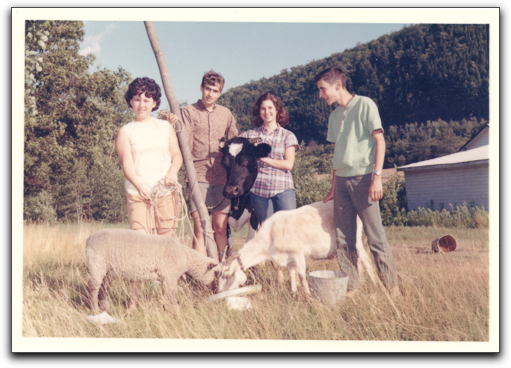
The Year Course itself was a wonderful experience. Though while many of the other participants were thrilled by the Southern-California-like appearance of Israel, I (having grown up in Southern California) wondered why anyone would (should) feel any special connection to the land if it were not for the Zionist idea (which was one of our textbooks). Throughout the autumn and winter we lived in what was then the quiet and small city of “divided” Jerusalem. After breakfast at our “dorm” the San Remo hotel on the corner of Strauss and HaNevi’im, we walked every morning, up King George Street to what was then the Hillel building on Balfour Street for four hours of Hebrew study. The afternoons were filled with courses in Jewish history, philosophy, and Zionist thought, the physical geography of Israel and more. The remainder of the year included a month living with a family and working on a moshav (Kfar Yehoshua), three months on various kibbutzim (Hulda), and other adventures.
On our return, I remember a woman from Hadassah, at the time, one of the adult sponsoring organizations of Young Judaea, remarking that they often see graduates of the Year Course returning to the States and becoming involved in Jewish communal life on a professional level… sometimes as rabbis. The Jerusalem campus of HUC-JIR had opened the year before my Year Course. I had walked past it many times. Little did I know then that in eight years I would be back, studying at that campus. I know of other colleagues who also “came through” Young Judaea.
listen to the promise
Since that October walk I have had other opportunities to listen to this “Promised” podcast. While I am not sure what it is that is promised, nor who it is that does the promising, I know that each time I have listened I have gained through the interaction of the three primary participants:
- Dr. Eilon Schwartz, founding Director of Shaharit as well as the Heschel Center for Environmental Learning and Leadership and Hebrew University professor
- Don Futterman, frequent contributor to Haaretz, blogger for +972, and Israel Program Director of the Moriah Fund
- Dr. Noah Efron, Sr. Fellow at Shaharit, HUffPo blogger and lecturer at Bar Ilan Univesity.
The whole first third of the October 28th podcast is all about the state of higher ed in Israel.
I encourage you to give it a listen.
listen to the dawn
Many organizations, especially youth movements have produced lapel buttons. I have a number of these made by Young Judaea. For some reason, Young Judaea has also been known as “Hashachar” (the dawn). This button dates from the mid 1970s the period when the podcast producers were active in the movement. I wonder if they ever wore it.
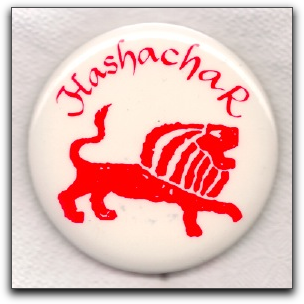
| Date: | 1970s |
| Size: | 5.2 |
| Pin Form: | straight |
| Print Method: | cello |
| Text: | HashachaR |
your lapel buttons
Many people have lapel buttons. They may be attached to a favorite hat or jacket you no longer wear or poked into a cork-board on your wall. If you have any lying around that you do not feel emotionally attached to, please let me know. I preserve these for the Jewish people. At some point, they will all go to an appropriate museum. You can see all the buttons shared to date.
Did I know that you were a Music major??
This was such a great post. Though I love music, I too find the silence to be filled with rhythms and timbres that have melodies of their own. Melodies I would not want to mask with external sounds.
I look forward to listening to these podcasts. Thanks so much!
Frume,
Thank you. I’m glad you enjoyed it and will explore the podcasts.
Though we first met over 10 years ago, I’m sure that there are many things about each other we’ve yet to learn. Though my “instrument of choice” is the recorder, I moved on to composition. While my most “famous” composition is the one described in the who is Mark Hurvitz page, I’ve not written any more about it. You can read about another composition on the page where I describe a radio program my brother and I produced in the late ’60s.
I was (still am) interested in live, aleatoric, electronic music.
Believe it or not, there’s a path that I followed from there to communal liturgy.