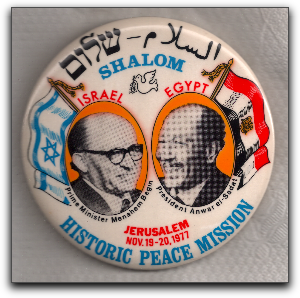
back then
I understand that during the first half of the 20th century not even the majority of world Jewry supported a nationalist solution to Jewish existence. Jewish working class movements were generally non-Zionist and many of the “leaders” of world Jewry were internationalists, looking for international solutions. Why, then, should I be surprised that the Palestinian people did not recognize nationalism as potent force in their own approach to modernity? As I wrote in a leaflet I published in 2002:
Who Are the Palestinians?
- We consider Palestine as part of Arab Syria, as it has never been separated from it at any time. We are connected with it by national, religious, linguistic, natural, economic and geographical bonds.
Resolution adopted by the First Congress of Muslim-Christian Associations; Jerusalem, February, 1919 at a meeting to choose representatives for the Paris Peace Conference
- There is no such country [as Palestine]! “Palestine” is a term the Zionists invented! There is no Palestine in the Bible. Our country was for centuries part of Syria.
The words of Auni Bey Abdul-Hadi, local Arab Leader to the Peel Commission (which came up with the suggestion to partition the Land of Israel) in 1937
- There is no such thing as “Palestine” in history, absolutely not.
Testimony of distinguished Arab-American historian, Princeton University Prof. Philip Hitti, before the Anglo-American Committee 1946
- Palestine was part of the Province of Syria… politically, the Arabs of Palestine were not independent in the sense of forming a separate political entity.
Arab Higher Committee representative to the United Nations at the General Assembly, May, 1947
- It is common knowledge that Palestine is nothing but southern Syria
Ahmed Shuqeiri (later chairman of the PLO) to the Security Council (a few years later)
The Palestinian people did not care about or build a national movement until Israel acquired control of the West Bank and Gaza following the Six-Day War in 1967.
Now that Palestinian nationalism is a force, the Palestinians must recognize the right of the Jewish people to its national movement: Zionism.
Together, the two peoples can share the land.
“coulda shoulda”
So… (as I published in another leaflet at that time):
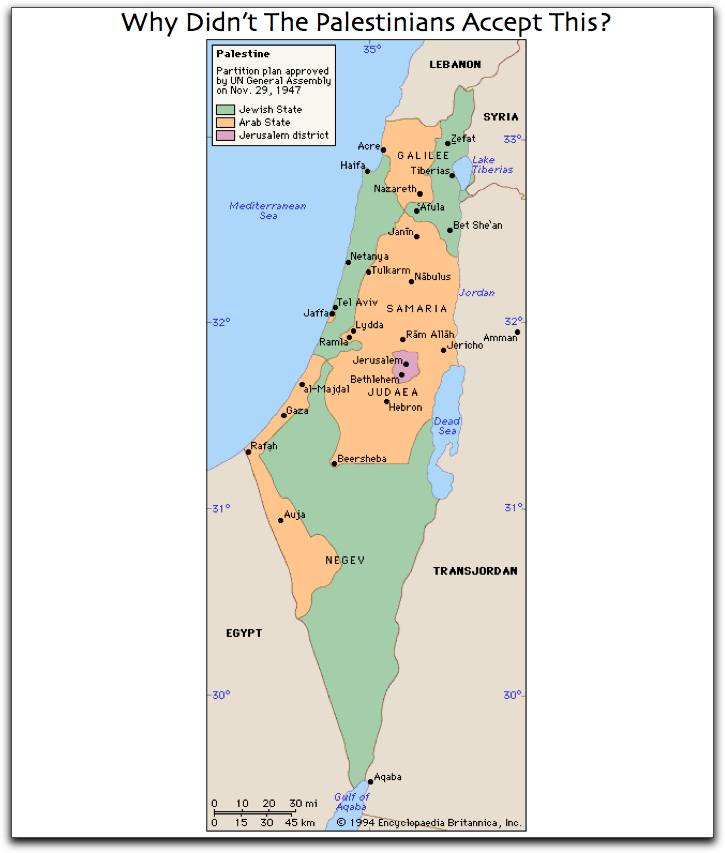
why not this?
According to United Nations Partition Plan of 1948 a Palestinian state was created at the same time as the State of Israel
It offered a lot more territory than the Camp David proposals of 2000!
which came first…
the nation or the state?
That’s a hard one to answer, as the Wikipedia article on “nation state” makes clear. I thought I could learn something about the predecessor of the modern nation state by looking at the concept of “the people” or “peoplehood”. But even here the ideas are scattered. The Wikipedia has articles on “Jewish Peoplehood” which has its origins in the Biblical concept of עם ישראל, expressed in early Rabbinic times as “Kol yisrael arevim zeh bazeh – All Israel are responsible for one another.” [Talmud Shevuot 39a] and is similar (probably a cognate word) to the Muslim concept of أمة “Ummah” and that idea is not all that far from the English word “folk”.
So, when Palestinian Authority President Mahmoud Abbas stood before the United Nations General Assembly on September 23, 2011, I wondered where he and his predecessors had been back in 1948! I imagine that others said “Nyah nyah, lost your chance.” But I am in favor of there being a State of Palestine alongside a State of Israel.
President Abbas’ address to UN; 1,585 viewings as of midnight 20110923 [part 1]
President Abbas’ address to UN; 302 viewings as of midnight 20110923 [part 2]
President Abbas’ address to UN; 304 viewings as of midnight 20110923 [part 3]
text of President Abbas’ address
I do, however, want to comment on this small part:
It is a moment of truth and my people are waiting to hear the answer of the world. Will it allow Israel to continue its occupation, the only occupation in the world?
Uh, Turkey, the current great defender of the Palestinians, occupies Cyprus, China occupies Tibet; do those not count? The Wikipedia article on occupied territories enumerates many others.
Will it allow Israel to remain a State above the law and accountability? Will it allow Israel to continue rejecting the resolutions of the Security Council and the General Assembly of the United Nations and the International Court of Justice and the positions of the overwhelming majority of countries in the world?
Why doesn’t anybody repeatedly complain about the Turkish or Chinese occupations, so there could be resolutions they would reject? Or why was there no outcry at the UN when using carpet bombing, Russia destroyed much of Grozny or when Turkey kills scores of Kurds?]
Excellencies,
Ladies and Gentlemen,
I come before you today from the Holy Land, the land of Palestine, the land of divine messages, ascension of the Prophet Muhammad (peace be upon him) and the birthplace of Jesus Christ (peace be upon him)
Um, at the time, it was known as the Kingdom of Israel or the Roman province of Judaea. What about Ahab king of Israel (peace be upon him) does he not count? Or, would mentioning him (and his title, I could mention so many more, but Ahab is attested to by the world powers of his day) falsify Abbas’ claim to “the Holy Land, the land of Palestine”?
to speak on behalf of the Palestinian people in the homeland and in the the Diaspora, to say, after 63 years of suffering of the ongoing Nakba
Ah hah! So it’s not “the occupation of the ‘West Bank’ ”, but the very creation of Israel that is the issue to Abbas. He’s let the cat out of the bag!:
Enough. It is time for the Palestinian people to gain their freedom and independence.
Well, yes, so why did not the Palestinian people accept the offer in 1948 and United Nations General Assembly (yes, the same group before which he delivers these remarks) Resolution 181?!
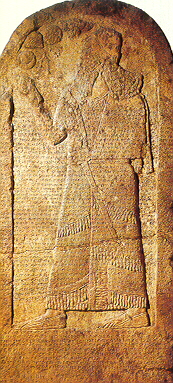
kurkh monolith of shalmaneser iii mentioning ahab king of israel
i am no fan of bibi either
Prime Minister Netanyahu’s address to UN; 304 viewings as of midnight 20110923
text of Prime Minister Netanyahu’s address
pandering
I wondered to whom Netanyahu was speaking when his opening remarks to the General Assembly dealt with the terrorist attacks of September 11, 2001 and he then went on to use the phrase “militant islam” five times in the first eighteen paragraphs. Was he directing his concerned remarks to the many Islamic states that are members of the UN, or was his audience the American public?
Yossi Verter writes in his column in Haaretz Nobel no, Oscar yes
In 1978, when it was learned that Prime Minister Menachem Begin had won the Nobel Peace Prize, former prime minister Golda Meir remarked: “He deserves a Nobel?” adding that what he really deserved was an Oscar.
If Golda were still with us, she could have resurrected her comment, this time with justification, with regard to Prime Minister Benjamin Netanyahu over his speech to the United Nations General Assembly on Friday.
Netanyahu began and ended his speech with calls for negotiations. Towards the end of his talk he seemed to address Mahmoud Abbas directly:
In two and a half years, we met in Jerusalem only once, even though my door has always been open to you. If you wish, I’ll come to Ramallah. Actually, I have a better suggestion. We’ve both just flown thousands of miles to New York. Now we’re in the same city. We’re in the same building. So let’s meet here today in the United Nations. (Applause.) Who’s there to stop us? What is there to stop us? If we genuinely want peace, what is there to stop us from meeting today and beginning peace negotiations?
Did Netanyahu call Abbas on his cell phone after the session? If not, why? If he did, what was Abbas’ response? Why have we not heard anything more about this? Or, was this no more than a form of grandstanding on Netanyahu’s part?
show business
I’m not the only one who has been critical of the pretensions of these leaders. Jeremy Ben-Ami, the founder of J Street, “the political home of the pro-Israel pro-Peace movement” appeared on the Colbert Report:
Jon Stewart satirized what it might take for Palestine to be admitted to the UN:
duplicity squared or goose and gander
There are enough half-truths and full lies tossed around to make one cry.
In his article Origins of the Palestinian Unilateral Declaration of Independence, Jonathan Schanzer writes extensively on all the diplomatic maneuvers (from upgrading diplomatic missions to full recognition of statehood by numerous countries) over a six-year period, as a lead-up to have Palestine admitted as a state at the UN, and then, in his final paragraph he wonders:
What Palestinian leaders plan to do in the aftermath of their maneuver at the UN remains to be seen. Their options range from a legal campaign to a series of nonviolent protests to a full-blown violent intifada. Regardless of which path they take—and it could be a combination—this initiative marks a new phase, now six years in duration,
and complains:
[that] Palestinian leaders have forsaken diplomacy in exchange for a position that may keep them at odds with Israel for many more years to come.
I think he means to state that they have forsaken negotiationswith Israel.
And what is so wrong with what Abbas has done? Is this not, as outlined by Samuel Moyn in his article: “Face the Nations; By asking the United Nations to fulfill their national aspirations, the Palestinians are following a script Israel’s founders wrote in the 1940s” analogous to what the pre-State leaders of Israel did in 1948? And has not Israel made a whole series of unilateral actions? Aside from building settlements in “disputed territory” there’s withdrawal from Gaza. Is not what’s good for the goose also good for the gander?
imagine a more positive outcome
It’s not as though nobody knew this was coming. As Schanzer made clear, a request for full membership in the UN has been in the works for six years. Even President Obama had hoped for an independent, sovereign state of Palestine by this time.
As a friend mentioned to me: “You gotta wonder how things would play out if Israel shocked the world by supporting the Palestine resolution at the UN and vowed to do everything it could to implement it peacefully.” I think (as usual) Bibi made a big mistake in not agreeing to this. A paragraph in an article in The New Yorker “Membership Dues” by Steve Coll suggests the perfect lead-up to the present situation:
Last year, President Barack Obama, in his annual speech to the General Assembly, devoted considerable attention to the Palestinian cause. He declared, in support of renewed talks with the government of Israeli Prime Minister Benjamin Netanyahu, “We can say this time will be different,” adding, “If we do, when we come back here next year, we can have an agreement that will lead to a new member of the United Nations—an independent, sovereign state of Palestine.” But that hope has not yielded a workable plan. Many Palestinian leaders have therefore concluded that it may be impossible to achieve statehood through negotiations with Netanyahu. Their pessimism is well grounded; the evidence suggests that he seeks only to fob off the Palestinian Authority, as well as his allies in the United States and Europe, in order to buy time to bankroll more settlements on the West Bank, which will change the contours of the conflict. Nor is there any sign that Israeli domestic politics will soon yield a coalition different from the type Netanyahu oversees, in which uncompromising, expansionist parties hold decisive influence.
but, you know, it probably doesn’t matter
Because, as in the original title of Associate Professor of Modern Arab Politics and Intellectual History at Columbia University, Joseph Massad’s article in Al Jazeerz: “Either Way, Israel Wins”.
Whether the UN grants the PA status as a state or refuses to do so, either outcome will be in Israel’s interest.
But, of course! It almost makes me appreciate the reasoning of Netanyahu. The comments to the article, well, I only read the first few of at least 18 pages. They’re a bit hard to take (I sorted by oldest first). I encourage you to steel yourself.
I still believe it should and can be different.
back in “the ’60s”
Yes, while I was alive in 1948, I have no recollection of that time. I do recall, however, wearing these two buttons together on my lapel during the early ’70s (which was a continuation of “the ’60s”). I sensed then, and still believe now that the two, no not directly dependent one on the other, go hand in hand. I can’t tell another people how to achieve its own self determination. However, when there is no more Arab terror against Israel and its citizens, more Israelis will feel free enough to encourage and want true self determination for Palestinians. And, so, it continues to pain me that these two “cousins” cannot seem to get their act together and “share their toys”.
|
|
|
|
|
Date: |
1974 |
1970s |
|
Size: |
3.8 |
3.8 |
|
Pin Form: |
straight |
straight |
|
Print Method: |
celluloid |
celluloid |
|
Text: |
STOP ARAB TERROR |
Self Determination for Palestine |
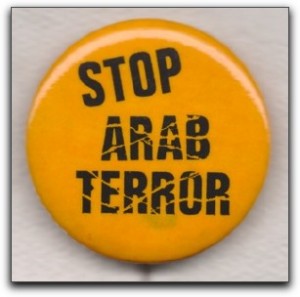
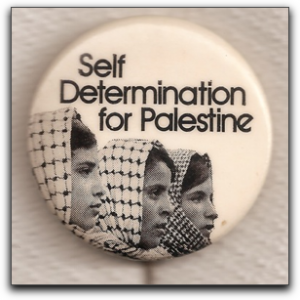
your lapel buttons
Many people have lapel buttons. They may be attached to a favorite hat or jacket you no longer wear, or poked into a cork-board on your wall. If you have any laying around that you do not feel emotionally attached to, please let me know. I preserve these for the Jewish people. At some point they will all go to an appropriate museum. You can see all the buttons shared to date.