virtual and real-life relationships
If you are reading this, you know that I believe in the value of “virtual” or “Internet relationships”, though not of the intimate kind. In fact, it’s written over there in the upper left corner [now, in 2021, in the right sidebar] that “For many years I have worked hard, and struggled with mastering virtuous. Now, in addition, I’m working on becoming more virtual.”
I have accounts (in alphabetical order… and I’m sure I’m missing some) on:
Not that I spend much time on the vast majority of them, but I’ve “staked out my territory” in these various virtual spaces.
brief encounters
Once or twice a day I leave our apartment for errands around the neighborhood. I interact with all of the tellers, clerks, doormen (whether of our building or others nearby), and other people I encounter during my brief walks. As Shammai (!) encouraged (Avot, 1:15) “receive everyone with a smile.” I’ll smile at anyone whose eyes I can catch. I have a friendly relationship with the man who sells bags and scarves on one of the corners near our apartment. I know when he’s gone home to his family in Africa and I give him a wide berth when he spreads out his rug for his prayers. We have never spoken of more than the weather and other little inconsequential subjects, and I’ve never bought anything from him, but we do not ignore each other. Nonetheless, I spend most of my days alone, by myself, in front of my computer, interacting virtually, digitally, electronically, with people all over the world whose faces I’ll likely never see.
However, Sunday, July 28, 2013, I needed to take care of an errand in Harold Square. On my walk there I turned down Madison Ave. and was pleased to see a street fair stretching from 57th down to 42nd street. I don’t purchase anything at these fairs, but I like to see what’s offered and it’s fun to walk down the middle of the street and see all the people “face to face”.
On my walk, I was a bit surprised to see, among all the booths for scarves, socks, hats, handmade jewelry, silkscreened tee shirts, and food of nearly every ethnic variety, a number of 6‑foot tables maintained by Jewish organizations. Each of these groups has an active social media presence. But I was glad to see real people.
one
The first table I encountered was that of Habonim Dror, The Labor Zionist Youth Movement. I paused to say how nice it was to see their table. I identified myself as someone who had once worn the blue חולצה, at one time with the red lace

the Habonim blue חולצה with its red lace
and at another time with a white one [in this photo Debbie and I met a Hashomer Hatzair group on an outing in Vienna during our visit in 2006].
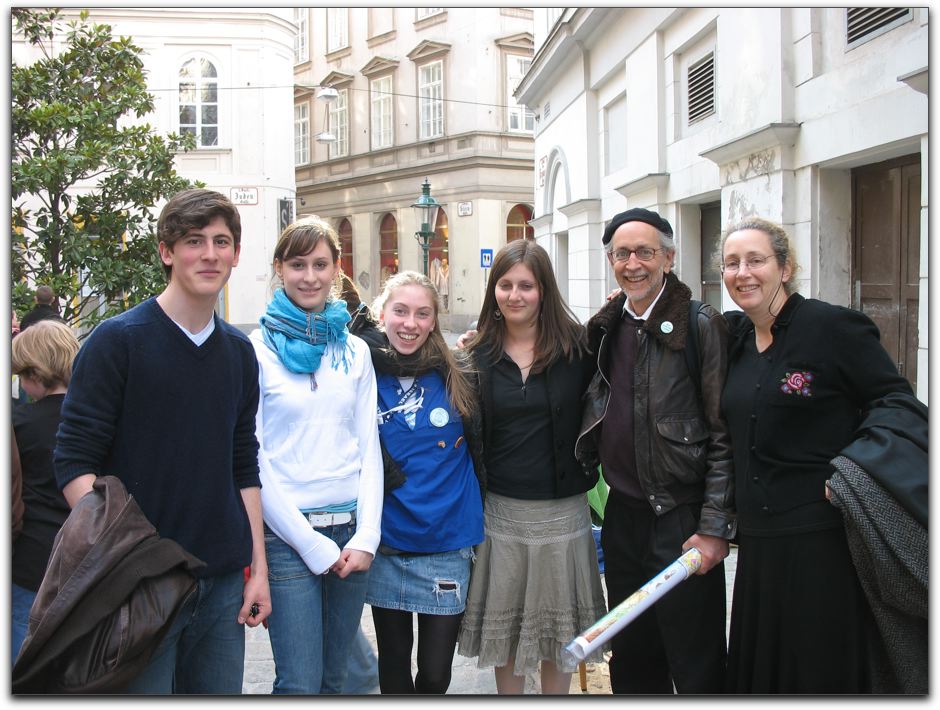
the hashomer blue חולצה with its white lace
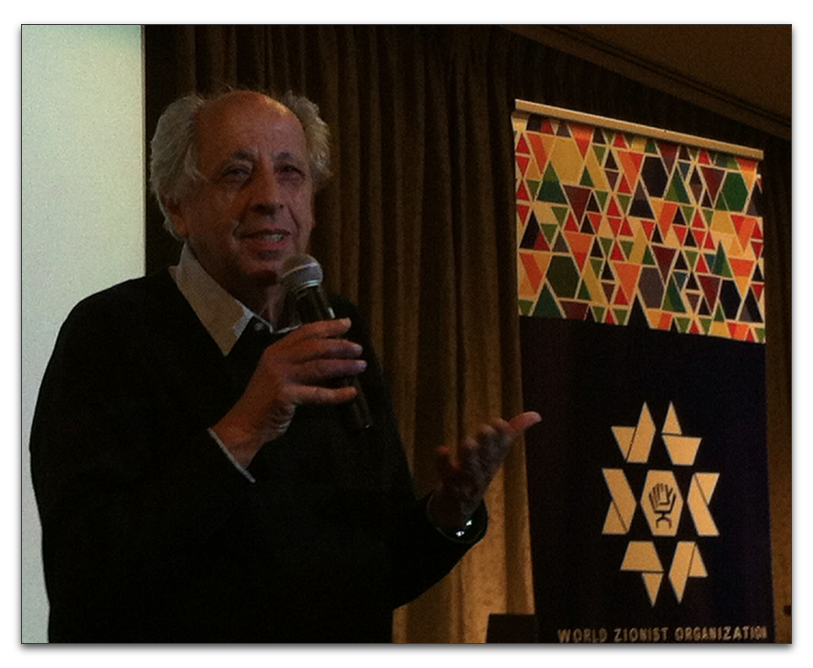
The young woman at the table asked me to sign a petition, which I did. And I mentioned that I had sat next to a table of Habonimniks when I attended an event at which Muki Tzur had spoken on Monday, May 6th, 2013.
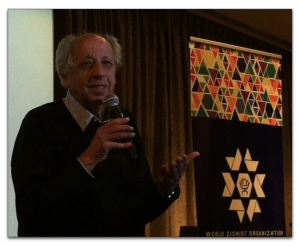
Muki Tzur speaks in NYC
Because that event was barely a week before Shavuot, I made a point of mentioning “Tweet #Torah to the Top”. Everyone at the table expressed interest… but on the day before Shavuot, I saw no tweets that looked as though they might have come from Habonim (nothing about the “religion of labor”). I mentioned the Twitter project to the young woman at the table. She remembered the Muki Tzur event and apologized that Habonim had not followed up on Tweeting #Torah. She thought it is a good idea and offered to pursue it further for the coming year. Of all the literature on the table, the only thing I took was her business card as a physical reminder that I should follow up.
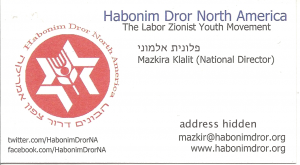
habonim calling card (personal and geographic information removed)
two
A couple of blocks further on I came upon the table of the Workmen’s Circle/Arbeter Ring. Once again, I reviewed the literature available. I indicated that I am already on the email list and then mentioned “Tweet #Torah to the Top”. I said that as far as I was concerned the writings of Mendele, Sholem Aleichem, and Peretz were appropriate for sharing as Torah and I hoped that they would participate in the coming year. And again, my physical presence right there in front of the people maintaining the literature table (not that I’m so charismatic) seemed to make a difference in the acceptance level of what I suggested.
Again, all I took was their business card.

workmen’s circle calling card
three
Further along on my walk, I was pleased to see the literature table of Jews for Racial & Economic Justice, a new entrant to the organized Jewish left. This time, again, I explained that I am (as with the previous two organizations) already on their email list and that I was familiar with their literature. We joked a bit about how they were encouraging me to take dead-tree material. And those maintaining the table expressed interest in my pre-Shavuot online #Torah study. But they did not have a business card I could take.
four
And then, last, near 42nd street I saw the table of HIAS. The workers at the table offered me an off-print of the article about HIAS’s change of focus, but I was able to turn it down by telling them that I had already seen it in the JTA. We spoke about how wonderful it is to be connected virtually and I explained my “Tweeting #Torah” “organizing project”. They were intrigued and requested that I contact them about participating. The one thing I did take from their table: the business card, again, as a physical reminder.
hias calling card
Note that each of the cards has social media links printed on them. When such existed (Workmen’s Circle & HIAS) I scanned the “back side” which does not include the person’s name and geographic address.
There were no lapel buttons on any of the tables along with the dead-tree literature. I had not expected to meet anyone when I left the apartment, so I did not put on a button that might have been of interest to those I encountered. If I had known, I might have worn one of these.
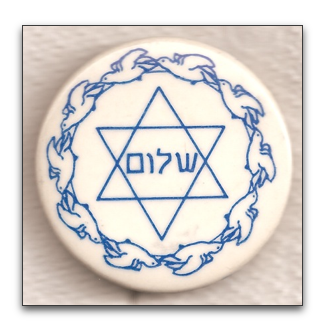
שלום button produced by habonim
| Date: |
1970s |
| Size: |
3.7 |
| Pin Form: |
straight |
| Print Method: |
celluloid |
| Text |
שלום |
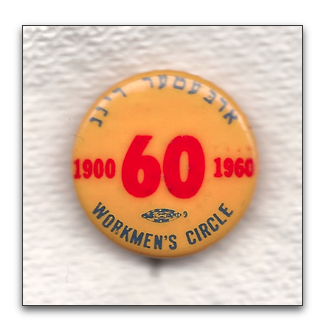
60th anniversary of the workmen’s circle
| Date: |
1960 |
| Size: |
2.2 |
| Pin Form: |
straight |
| Print Method: |
celluloid |
| Text |
ארבעטער רינג
1900 60 1960
WORKMEN’S CIRCLE |

united hias service
| Date: |
1970s |
| Size: |
5.7 |
| Pin Form: |
clasp |
| Print Method: |
celluloid |
| Text |
UNITED
HIAS
SERVICE |
your lapel buttons
Many people have lapel buttons. They may be attached to a favorite hat or jacket you no longer wear or poked into a cork-board on your wall. If you have any lying around that you do not feel emotionally attached to, please let me know. I preserve these for the Jewish people. At some point, they will all go to an appropriate museum. You can see all the buttons shared to date.
back to back, belly to belly
Because zombies have been popular this summer and I had “face to face” on my mind, I decided I should also share some “back to back, belly to belly…”
timely reminder
These meetings with real people are important. They remind me as the month of Elul is about to begin that I cannot rely on blanket virtual apologies. I have brought my “preparing for ראש השנה & יום כיפור” materials up to the top of the right sidebar for the season. They are there for me and others to use to help focus on the tasks ahead. Let’s not act like zombies. Rather, may we truly encounter those others we have wronged, face to face… because “all real living is meeting”, look them in their eyes and unflinchingly (or even flinchingly… it’s not easy) express our regret for the specific ways in which we have wronged them.
following up…
This post is a bit of a reminder to each of those I met. I will email them and let them know I’m available to help and I hope they will spread the word.