changing technologies
originally published October 2011; updated August 2018
Most people who know me understand that I am not averse to technological change. I have been interested in how communications technologies have been used and changed for many years. In June of 2010, I wrote about my involvement in the development of what I called “the electronic leaflet”. When I was in college I studied music and was involved in performing “renaissance music” on my recorder at the same time, as I have written here before, I produced and was the disk jockey for “avant garde” music on the radio program “Catching Up” on KPFK I had with my brother. My interest in changing communications technologies led me to write my rabbinic thesis on ”The Rabbinic Perception of Printing as Depicted in Haskamot and Responsa (contemporary with the invention of printing). I wanted to learn what the rabbis contemporary with the invention of the new technology felt and thought about it (there was precious little information).
The Google books QR Code for my thesis:
letters and cards
One item that printing enabled was the development of postal systems. Once you could print on paper that had a dried glue on the back that you could use affix to an envelope or card, written communications between people who lived far from each other increased greatly. It meant that the sender of an item paid for its delivery in advance. Among the many items sent were cards with photographs or illustrations on them: the postacard.
Jews around the world participated in this development. As the Jewish population spread across Europe to America and beyond, the ability to hold something written and tangible gained deep import. People spoke of having papirene kinder “paper children” because the only evidence they had of them was the letters they hopefully received. The concept has made it into a 2003 novel by Martha Blum called Paper Children, and a Yiddish song that seems to date from the earliest part of the 20th century. Deeply poignant is the movie A Brivele Der Mamen, the title song from which, written at least 30 years earlier, rends the heart and brings tears to the eyes. The song was first recorded by it’s composer Solomon Smulewitz in 1908. It became popular on its own with covers by The Barry Sisters. It begins in three-quarter time, but the famous lyrics, as sung by the popular singer Al Bowlly are a fox trot.
|
||||||
The version on YouTube by Dudu Fisher includes (what I think is) a still from the 1938 movie (note the envelope on the table):
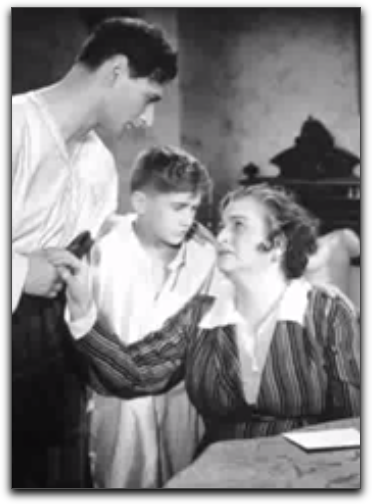
still from “a brivele der mame”
rosh hashannah correspondence
Postcards at the time of Rosh haShannah played an important role. As explained in an online exhibit Past Perfect at the Jewish Theological Seminary of America:
The earliest and largest number of Jewish picture postcards were created for Rosh Ha-Shanah greetings. The custom of sending a New Year’s message is documented as early as the fourteenth century when the Maharil, Rabbi Jacob of Moellin (1360?-1427) [in Mainz of all places; he died just under 25 years before Gutenberg developed movable type there, centuries before postcards], recommended that during the month of Elul one should include wishes for a good year in all written correspondence. This custom spread widely throughout the Ashkenazic world.
Some lovely cards are available at the JTSA site. You can see many more at the Magnes Museum site. You can almost always find some old Rosh haShannah postcards to purchase on eBay. and you can buy new cards that you can write on at zazzle. One of the reasons I have enjoyed receiving hard, analog, physical, printed-on-paper Rosh haShannah cards is that I can decorate my Succah with the cards I’ve received from friends and family that year. It is a physical form of ushpizin.
I find it cute and intriguing that one of the older cards depicts a newer mode of communication:

a little meta
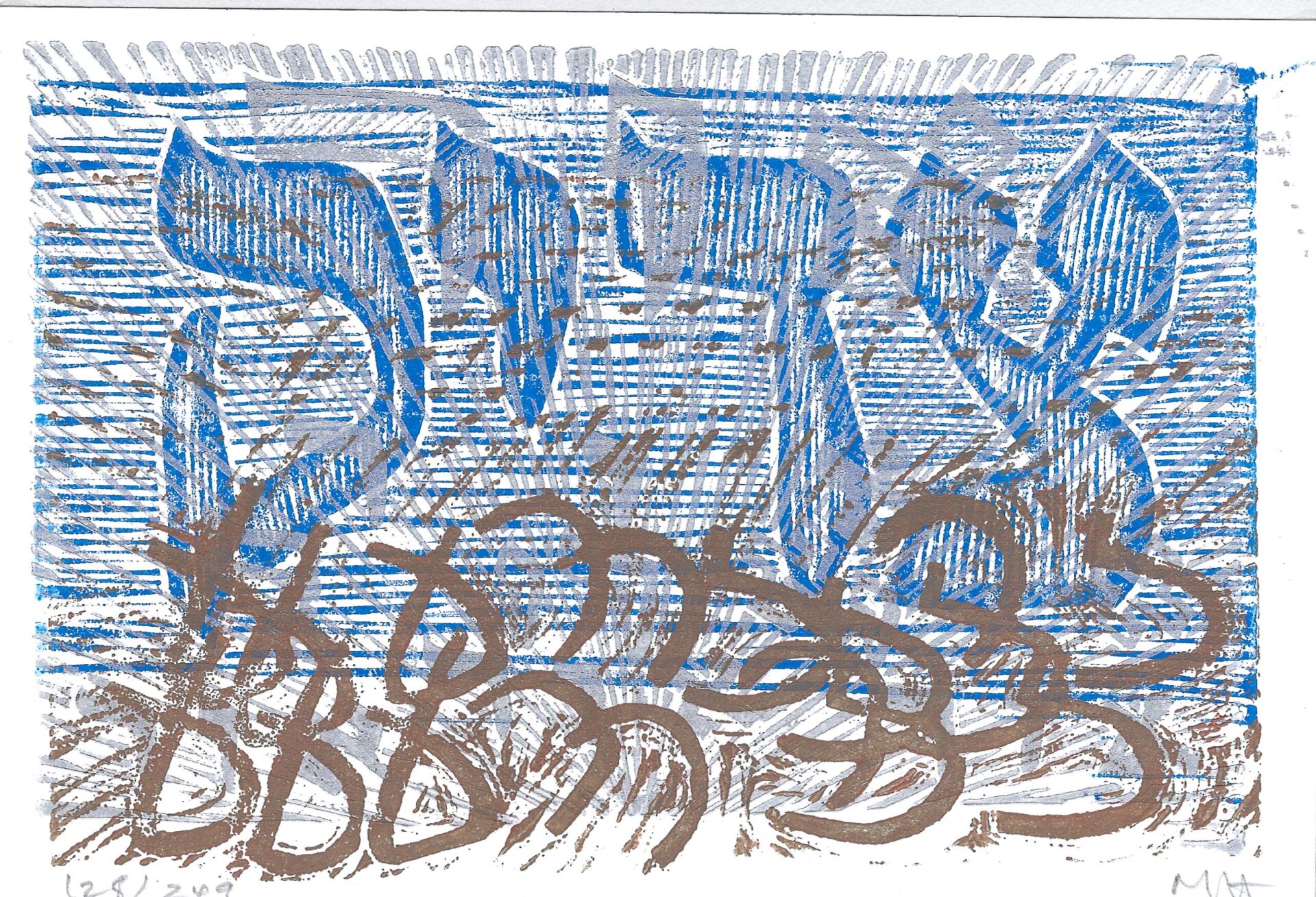
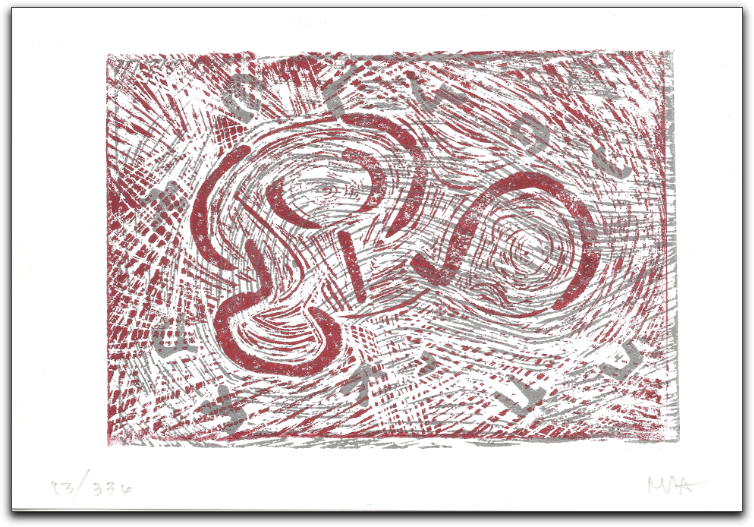
I rarely write about the process of maintaining this site. Some may notice that I change the color scheme on an annual basis. The colors for links, blockquotes, tables, and other features are based on the colors of the image you see at the top of the (at this writing) right sidebar. That image is a miniature of a linoleum block print that I prepare and send out as my own Rosh haShannah greeting card. Since 1996 I have used a portion of my summer (at one time at camp (Swig or Newman)) to produce a linoleum block (or other visual). Each block represents a verse from classic Jewish texts. Initially, (usually) these texts were from the book of Psalms, but now they range much more widely. Each text becomes a mini visual midrash. I collect them here for your viewing pleasure.
Psalm 16:8 1996 For a new year of peace Psalm 113:3 1997 May the year 5758 bring blessings of peace from east to west… Isaiah 45:7 1998 May the year 5759 bring blessings of peace in both light and darkness. Psalm 119:1 1999 May the new year 5760 bring blessings of peace as we continue on our way. Psalm 92:13 2000 May justice… and with it peace flourish in the new year 5761. Psalm 90:12 2001 May we gain hearts of wisdom, so that the year 5762 will be one of peace. Psalm 118:19 2002 May acts of righteousness in the year 5763 open the Golden gates of Mercy and lead to a world of peace. Proverbs 3:17b 2003 May all our paths in the coming year 5764 lead us toward peace. Sifra to Psalm 18:11–12 and Siddur: Ma’ariv: Hashkiveinu 2004 May our efforts in the year 5765 spread clouds of glory as we build true tabernacles of peace. Lamentations 3:52 2005 May our endeavors in the year 5766 release all that threatens to ensnare us, giving wing to a world of peace, blessing and joy.
[In memory of Faye (Faigie, Fannie (Avrunin)) Hurvitz Tzipporah bat Meir v’Jannah 21st of Tevet 5674 — 8th of Tammuz 5765; December 20, 1913 (the winter solstice) — July 14, 2005]Leviticus 25:10 2006 May our endeavors in the year 5767 proclaim liberty throughout the land, creating a world at peace. Psalm 118:5 2007 May our voices spread from the narrow places to the broad spaces calling for justice and peace in the year 5768. Psalm 118:22 2008 In our efforts to build a world at peace may we see the potential in every stone. Leviticus 19:10b 2009 As we gather our share in the new year may we live in a world of plenty and of peace. Pirei Avot 1:2 2010 May we secure our world on a foundation of learning, service and deeds of loving-kindness. Genesis 1:1–2 2011 May our efforts in the new year bring new creation out of chaos. Psalm 130:1b 2012 May our voices reach up from the depths to achieve a world of wholeness and peace. Deuteronomy 30:13 2013 May our efforts in the New Year bring a world of wholeness and peace closer to us. Psalm 23:5b 2014 May our efforts in the New Year overflow with goodness and help create a world of wholeness and peace. Psalm 27:9a 2015 May the new year be a time of honesty with ourselves and full presence with one another, bringing us closer to a world of wholeness and peace. Siddur : Kedushat haYom 2016 With purified hearts may our honest efforts build a world of justice and peace. Psalm 1:3 2017 May we plant ourselves by sources of sustenance and use those sources to build a world of peace and plenty.
I often spend the months immediately following Pesach thinking of a verse that would be appropriate and could be expressed visually. This year’s card is made of two blocks. I did not know it would work this way, but the shop where I usually purchase the linoleum had a block approximately twice the size of what I wanted. I was able to find someone who could cut it in half, and then I had two pieces to work with. In recent years, more of the cards have reflected something in my life at the time; this year is one of them.
- I took the two verses:
בְּרֵאשִׁית, בָּרָא אֱלֹהִים, אֵת הַשָּׁמַיִם, וְאֵת הָאָרֶץ. וְהָאָרֶץ, הָיְתָה תֹהוּ וָבֹהוּ, וְחֹשֶׁךְ, עַל‑פְּנֵי תְהוֹם; וְרוּחַ אֱלֹהִים, מְרַחֶפֶת עַל‑פְּנֵי הַמָּיִם
- I removed all the vowels and duplicate (as well as final form) letters. This left me with [set one]:
א ח י כ ל מ נ ע פ צ ר ש
- I removed/separated those that form the phrase [set two]:
תֹהוּ וָבֹהוּ
- I randomized the remaining letters.
- These two sets formed the two linoleum cuts:
randomized (the letters, and the cuts that make up the design, enclose a rounded area):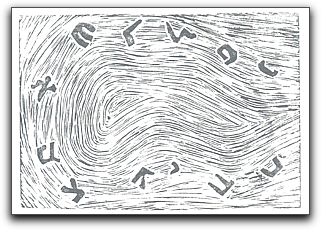
randomized letters
remaining (the letters/words, read right to left, then flipped… and right to left again, form a shape in the fetal position while the cuts that extend from the letters shoot off in all directions):
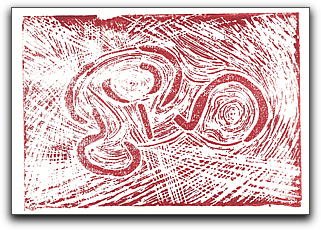
tohu va vohu
- I printed the silver-gray block and then, on top of that the red block:
genesis 1:1–2
whatever happened?
In the days when I taught my Introduction to Judaism class, part of the lesson for Rosh haShannah was to explain the value of making contact with family and friends, as Christians do at Christmas. In a sense, it is a way to ping someone. I send out a card to every member of my extended family for whom I have a geographical address as well as numerous friends and associates. Often I receive a card in response. Sometimes a card comes back with “address unknown” or “past forwarding time”. Others respond by sending an electronic greeting, or, there are families who send out a “this is what our family has been up to this past year” letter. Generally, if I do not receive any kind of response after three to five years, I drop that recipient from the list (those of you who happen to read this and are on the list… be forewarned). Because I have included a number of people with whom our parents corresponded I sometimes receive notes back letting me know that a particular person has died in the past year and I notify my sibs as we take note of the passing of time and generations.
I usually print enough cards so that our children can use them to send to their extended family and friends. However, other than that, it seems fewer people each year send cards out on their own. This saddens me, but, it seems that, other than modeling the behavior I like, I am powerless to change the situation.
you can send these cards as well
I have reproductions of the cards available for purchase at my Zazzle store. You can purchase them to send to your family and friends.
keep them coming
I don’t know if these phrases are used any longer, but there was a time when they played a significant role in American popular culture.
Thank you for all those cards and letters:
Keep those cards and letters coming in
(which I understand was a special part of The Dean Martin Comedy Hour”) though this is from a different source:
not averse to change
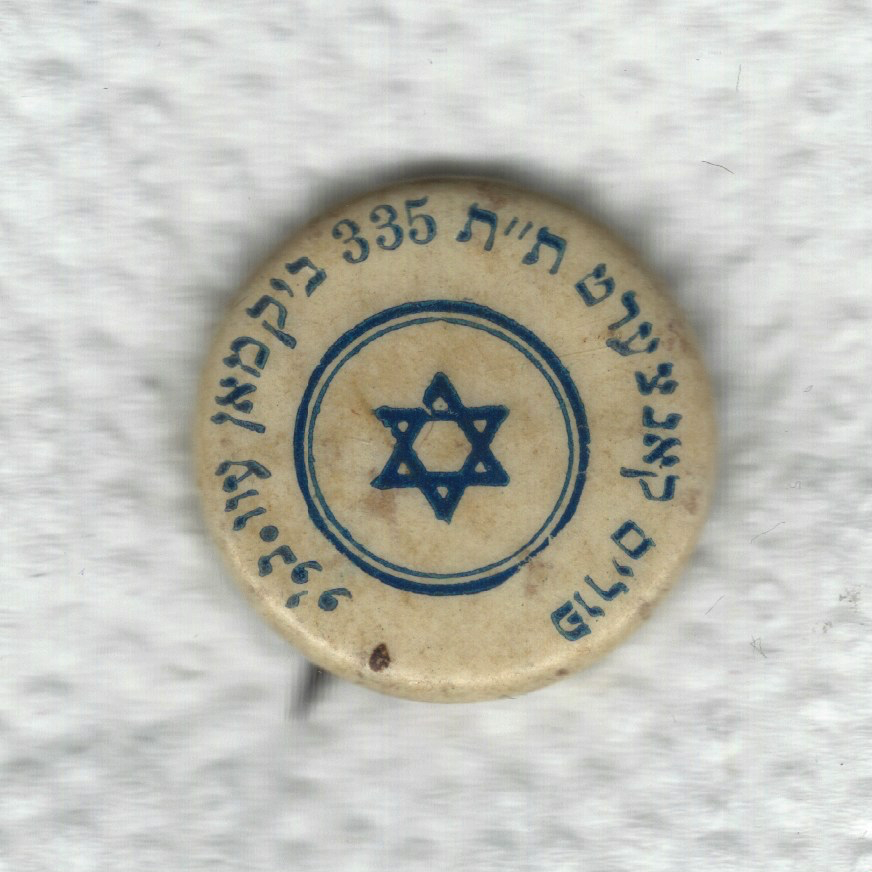
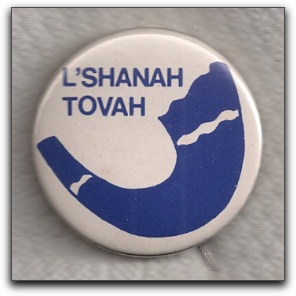
Yes, I do miss receiving those physical cards. But, that does not mean that I will not express my Rosh haShannah greetings in a less “traditional” manner. I will wish my Twitter followers a Shannah Tovah (with a link to this page). I will also add a note to my Facebook page that I’ve updated this site in honor of the new year, and I will even share the first paragraph of this, with a link on Google+. Beyond those virtual wishes, I often wear this button during the period leading up to and immediately following Rosh haShannah.
l’shanah tova
| Date: | 1970s |
| Size: | 3.8 |
| Pin Form: | clasp |
| Print Method: | celluloid |
| Text | L’SHANAH TOVAH |
your lapel buttons
Many people have lapel buttons. They may be attached to a favorite hat or jacket you no longer wear, or poked into a cork-board on your wall. If you have any laying around that you do not feel emotionally attached to, please let me know. I preserve these for the Jewish people. At some point they will all go to an appropriate museum. You can see all the buttons shared to date.