queen city of the west
When Debbie and I decided to continue our rabbinic studies at the Cincinnati, Ohio campus of HUC-JIR rather than at the New York campus, a number of our friends made fun of us. They joked that we’d spend all our time in rocking chairs on the porch of our apartment. We actually had a number of positive reasons for wanting to study in Cincinnati (as well as a variety of negative reasons for not studying in NYC).
- Debbie could work in the museum on the campus in Cincinnati as she had in Los Angeles.
- Mark could work in the Klau Library (one of the premier Judaic libraries) and even, perhaps the rare book room.
- Mark could study American Jewish history with Jacob Rader Marcus and use the resources of the American Jewish Archives.
- Being coastal, big-city kids, this would be a chance to experience the middle of the country, it was more likely that the two of us would find jobs in a big city on one of the coasts after ordination, than in “flyover” country.
- The slower pace of Cincinnati would enable us to focus on our studies… the actual purpose of our being in school.
- …and this was the mirror image of why NYC was not such a great idea for us, in New York, we would be busy trying to earn enough money to afford to live in NYC and then not have either the time or the money to take advantage of all the distractions from our studies that NYC has to offer.
Cincinnati was an excellent choice. We did explore The Midwest, as well as The South. We met lovely people and we even went to a baseball game.
on to the big apple
On ordination, R. Sheldon Zimmerman and his laypeople offered Debbie a position as assistant rabbi at Central Synagogue in New York City. We moved to NYC and found an apartment within walking distance of the synagogue (on 64th near 1st). I pursued a number of my old Federation contacts and was able to get a job in the Leadership Development Division of the UJA-Federation Campaign.
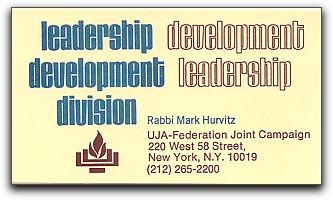
mark’s business card
My primary responsibility at the Campaign was in “community organizing” or “outreach” to work with committees of young donors (25–35ish Jewish “Yuppies”) to create activities around New York City that would attract many others of their peers. These events should have some Judaic content, as well as a large social component. The people we attracted and involved would ultimately be invited to fund-raising events and hopefully become active in the Jewish community.
One of the volunteers was a lovely young woman who met and married a bright and engaging young rabbi who had been a participant/speaker for one of our programs. Having grown up in an Orthodox environment he was accustomed to saying Mazal Tov to everyone at a simcha. They produced a button that they distributed at their wedding which served as a way to extend that greeting.
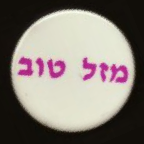
מזל טוב button from a wedding
Sadly (as sometimes happens) the backing has separated from the front and I can not wear it.
The couple (though now divorced) has two grown children.
The rabbi continues to distribute the buttons occasionally (now in its third edition) at Brit Milah ceremonies, Bar Mitzvah celebrations and other joyous occasions.
and back
Many years have passed since then. That wedding was in 1981. I have not learned about any other couples who have produced buttons to share at their weddings. But, this weekend Noam and Rachel are getting married. The two of them have been living in New York (Brooklyn) with Avigail. Rachel’s parents live in Cincinnati where Rachel grew up. The joyous wedding will occur at a lovely spot along the Little Miami River. In joyous anticipation, I have been wearing a button I purchased on eBay in April of 2009 from someone living in Lakeland, Florida. I do not know why it was made or for whom.
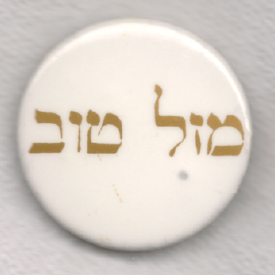
מזל טוב
| Date: | ? |
| Size: | 3.8 |
| Pin Form: | clasp |
| Print Method: | celluloid |
| Text | מזל טוב |
your lapel buttons
Many people have lapel buttons. They may be attached to a favorite hat or jacket you no longer wear, or poked into a cork-board on your wall. If you have any laying around that you do not feel emotionally attached to, please let me know. I preserve these for the Jewish people. At some point they will all go to an appropriate museum. You can see all the buttons shared to date.