jews and judaism in american elite culture .01
On Sunday evening, November 8, 2009 I attended “Steve Reich Talks about his Jewish Music at JMF”. I was a bit surprised (after being told to reserve my free tickets in advance) that there were perhaps fifty people in the hall waiting to hear the words of this very popular contemporary composer. Most in attendance were older than I.
Steve Reich grew up in a very assimilated, (perhaps) Reform affiliated “family” (his parents, divorced when he was a baby, lived in NYC and Los Angeles). I think they were quite comfortable as evidenced by his personal experience that forms the backdrop for his composition Different Trains:
During the war years, Reich made train journeys between New York and Los Angeles to visit his parents, who had separated. Years later, he pondered the fact that, as a Jew, had he been in Europe instead of the United States at that time, he might have been traveling in Holocaust trains.
He was in the Berkeley area at just the right time:
Subsequently he attended Mills College in Oakland, California, where he studied with Luciano Berio and Darius Milhaud (1961–1963)
your own backyard
His minimal Jewish connections and the developing interest in Eastern spiritual systems in the Bay Area at the time lead him to TM and other similar activities. He referred to this in his comments, though he did not phrase the Jewish portion the way I did. After many years of… well you know, the usual… he found what he “was looking for in his own backyard”. (I’m tired of this “own-backyard-finding”.) He was in NYC and “found” (how was not made clear) rabbis Shlomo (then Steven) Riskin and Ephraim Buchwald who set him on the “right path” [my words, his attitude]. He is now a Ba’al Teshuvah. Though he says he is not a “baal” (a master), only struggling with “teshuvah” (returning). Many photos of him show him with a visor cap: his kippah. This is how he dressed when he spoke at the Center for Jewish History. (I like the earth tones.)
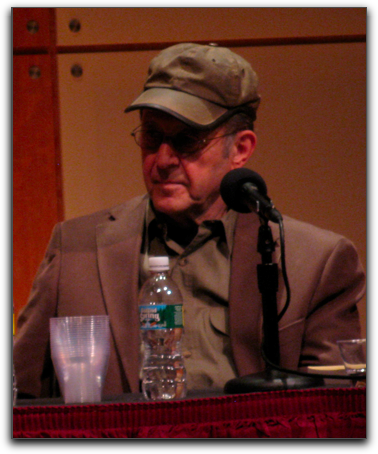
Steve Reich at the Center for Jewish History
my coming out with reich
Jay and I first encountered Reich’s music in the mid-to-late 1960s. I had recordings of It’s Gonna Rain (which is very long; a brief explanation of the composition process and snippet of the piece itself appear about halfway through the following YouTube video)
and Come Out (one of my all-time favorite compositions; click the right-pointing triangle to hear a 30 second snippet. or “Play full song here” to be taken to another site where you can hear all 13 minutes; you may need to register to listen). Jay and I broadcast Come Out frequently on our radio show Catching Up.
jewish? music

get חי on jewish music
| Date: | 1990s? |
| Size: | 3.7 |
| Pin Form: | clasp |
| Print Method: | celluloid |
| Text | Get חי on Jewish music |
In 1981 I invited my two cantors (Dick Botton and Jerrold Held) to join me and Debbie for the world premier of Tehillim. (If I remember correctly, it was performed in a small hall that is part of the Metropolitan Museum of Art.) I was thrilled to hear the piece. I’m not sure about the reactions of my guests.
no more humble
I will grant that, having won a Pulitzer Prize for composition, Steve Reich does not need to be humble. However (I’ve been wanting to use this quote from Oscar Levant in an appropriate context: “I am no more humble than my talents require.”), I believe he could use a bit of humility.
He is not pleasant.
Reich is very dismissive of any flavor of Jewish living that is not the orthopraxy that he has accepted for himself. And as for Jewish music he is contemptuous… unless it is what he considers the only Jewish music that is “Jewish”: Torah Chant. (It was interesting to hear him say this in the auditorium of the Center for Jewish History. I sat in the 7th row and two rows behind me were Jeffrey Shandler (at Rutgers, who I met via Barbara Kirshenblatt-Gimblett) and Mark Slobin (with whom I had a class in the mid 1980s at NYU… where I met Yale Strom), neither of whom are slouches in the field.
During the question and answer period I asked mine:
Are you aware of your music being used in a liturgical setting, and how would you feel if it was?
He responded with a tone of voice that approached anger: He is opposed to “liturgical” music. The only music in a Jewish religious setting should be the Torah chant, etc. and he writes (he did not use these words) “art” or “concert” music.
I [don’t] apologize
Following the formal part of the program I approached him. I explained my long association with his music. I then told him that it seemed I needed to apologize to him for using his music liturgically. I explained that I had sung Psalm 19:2–5 (the first movement of Tehillim), solo, a cappella, regularly for my congregation Etz Chaim of Ramona, over a 20-year period. He looked a little nonplussed and admitted that once he has written the music and sent it out into the world, he cannot control what people will do with it.
And, of course, he is quite correct in that. A number of the links here are to YouTube which include many “mashups” of his music, mashups that take his carefully arranged sounds and push them in directions he probably never imagined. I don’t feel bad at all about appropriating some of his music for liturgical purposes.
Reich spoke a bit of the relationship between popular and serious music. He is quoted elsewhere (and from there in the Wikipedia article about him):
All musicians in the past, starting with the middle ages were interested in popular music. (…) Béla Bartók’s music is made entirely of sources from Hungarian folk music. And Igor Stravinsky, although he lied about it, used all kinds of Russian sources for his early ballets. Kurt Weill’s great masterpiece Dreigroschenoper is using the cabaret-style of the Weimar Republic and that’s why it is such a masterpiece. Only artificial division between popular an [sic] classical music happened unfortunately through the blindness of Arnold Schoenberg and his followers to create an artificial wall, which never existed before him. In my generation we tore the wall down and now we are back to the normal situation, for example if Brian Eno or David Bowie come to me, and if popular musicians remix my music like The Orb or DJ Spooky it is a good thing. This is a natural normal regular historical way.
—From an Interview with Jakob Buhre
As I walked home, up 5th Avenue on a balmy, unusually warm, November evening, I felt disappointed. I felt sorry for Steve Reich, especially given his interest in Bartók, whose music Reich understands is so clearly based on the sources of his own people’s musical history. I find it strange that Reich is so disdainful of the popular music of the people from whom he is only three generations (at most) removed: klezmer. It is sad that he has, it seems, pompously determined that this is music not worthy of his interest. And I find it odd, that he believes that the music of the Torah chant is the same as what it was in late antiquity. After all, he knows, from his own musical composition style as a young man that subtle shifts of phase are quite natural and can cause amazingly beautiful new sounds. If, however, I have misunderstood him, or misconstrued, or misrepresented, I’m sorry.
A colleague (Rabbi Rachel Gurevitz) recently wrote about the last line of of the book of Psalms. There are some wonderful settings for these words. One is by my teacher Bonia Shur (whose huge eyebrows and fierce intensity frightened me as a young teenager in the Habonim makelah in the early 1960s in Los Angeles).
Another is the final movement of Tehillim by Steve Reich (sorry… “Embedding disabled by request”).
And so, in honor of all the contemporary klezmorim who work to bring one variant of Jewish music, un-apologetically, forward into the future, this button that celebrated a great day on Eldridge Street.

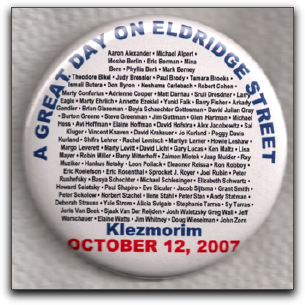
a great day on eldridge street
| Date: | October 12, 2007 |
| Size: | 5.5 |
| Pin Form: | clasp |
| Print Method: | celluloid |
| Text | A Great Day on Eldridge Street |
Aaron Alexander, Michael Alpert, Moshe Berlin Eric Berman, Mina Bern, Phyllis Berk, Mark Berney, Theodore Bikel, Judy Bressler, Paul Brody, Tamara Brooks, Ismail Butera, Don Byron, Neshama Carlebach, Robert Cohen, Marty Confurius, Adrienne Cooper, Matt Darriau, Peggy Davis, Srul Dresdner, Larry Eagle, Marty Ehrlich, Annette Ezekiel, Yankl Falk, Barry Fisher, Arkady Gendler, Brian Glassman, Beyle Schaechter Gottesman, David Julian Grey, Burton Greene, Steven Greenman, Jim Guttmann, Glen Hartman, Michael Hess, Avi Hoffman, Elaine Hoffman, David Hofstra, Alex Jacobowitz, Sal Kluger, Vincent Knaven, David Krakauer, Joe Kurland, Peggy Davis Kurland, Shifra Lerer, Rachel Lemisch, Marilyn Lerner, Howard Leshaw, Margo Leverett, Marty Levitt, David Licht, Gary Lucas, Ken Maltz, Lisa Mayer, Robin Miller, Barry Mitterhoff, Zalmen Mlotek, Jaap Mulder, Ray Muziker, Hankus Netsky, Leon Pollak, Eleanor Reissa, Ron Robboy, Eric Roelefson, Eric Rosenthal, Sprocket J. Royer, Joel Rubin, Peter Rushefsky, Paul Shapiro, Eve Sicular, Jacob Sijtsma, Grant Smith, Peter Sokolow, Norbert Stachel, Ilene Stahl, Peter Stan, Andy Statman, Deborah Strauss, Yale Strom, Alicia Svigals, Stephanie Tarras, Sy Tarras, Joris Van Beek, Sjaak Vav Der Reijden, Josh Waletsky, Greg Wall, Jeff Warschauer, Elaine Watts, Jim Whitney, Doug Wieselman, John Zorn
Klezmorim
October 12, 2007
your lapel buttons
Many people have lapel buttons. They may be attached to a favorite hat or jacket you no longer wear, or poked into a cork-board on your wall. If you have any laying around that you do not feel emotionally attached to, please let me know. I preserve these for the Jewish people. At some point they will all go to an appropriate museum. You can see all the buttons shared to date.