
jews and judaism in american popular culture .01
now, …with harvey and sheila!
There was a time, it feels strange to write this… a generation ago, when being Jewish was very “in”. The thing to be in America. Americans continue to, even increasingly, convert to Judaism in the 2000s. However, back in “The Sixties” some forms of Jewish culture were pervasive.
Hava Nagila was a semi-popular song and its melody was used both for serious political songs as when Lena Horne sang Now!
…and for silly lampoons such as Allan Sherman’s Harvey and Sheila
you don’t have to be
And, in fact, you did not even have to be Jewish to enjoy doing “Jewish” things, such as eating Levy’s rye bread.

one in a series of advertising posters for Levy’s real Jewish rye
This was so popular an idea that (perhaps tasteless) parodies of it appeared:
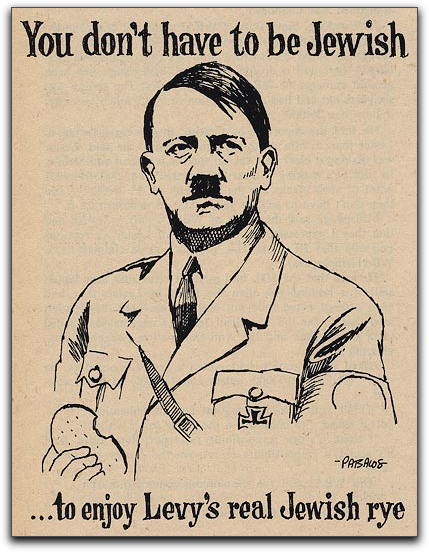
Hitler likes Levy’s Jewish rye
Nonetheless, times have changed and it is unusual to even find one loaf of Levy’s among the various options.
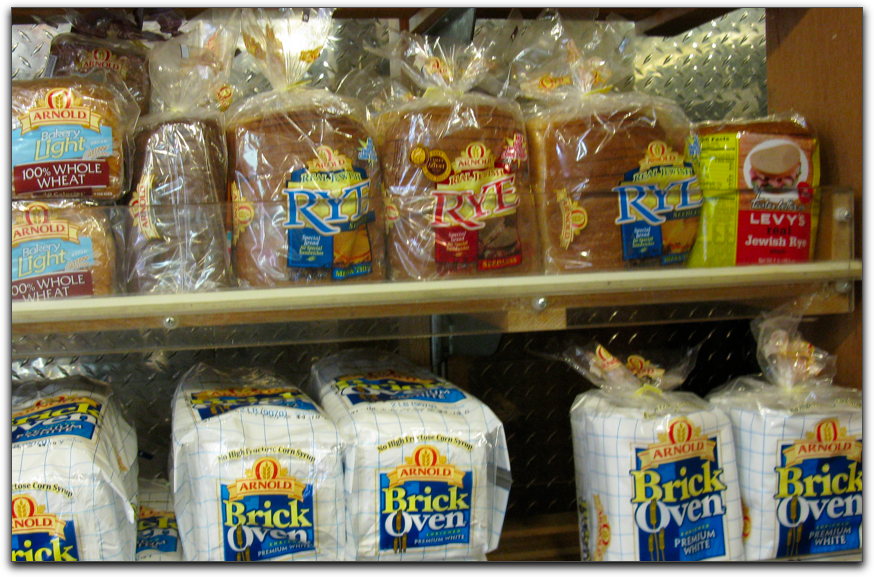
lonely Levy’s Jewish rye in 2009
“think different” ?
Long before Steve Jobs suggested that we “Think Different” the common wisdom was that, you might dress British, but you should Think Yiddish.
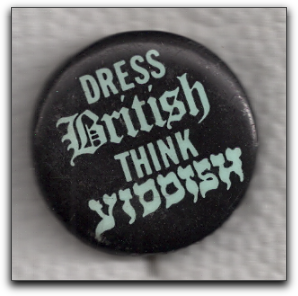
Dress British; Think Yiddish
| Date: | ca. 1967 |
| Size: | 3.175 |
| Pin Form: | straight |
| Print Method: | celluloid |
| Text | Dress British Think Yiddish |
Buttons such as that illustrated above were available from shops on MacDougal Street in Greenwich Village, NYC and elsewhere in major American cities. (In fact, I have four variants of it.)
yenta in paris
Yiddish words entered the mainstream of American literate conversation.
In 1964 Fiddler on the Roof opened on Broadway. It introduced (a watered-down version of) Eastern European Jewish culture to mainstream America and the world. One of the musical’s more colorful characters was “Yenta” the matchmaker. The Wikipedia suggests that “Yenta” is a personal name. This may be a case of “which came first the chicken or the egg”. The Yiddish Dictionary Online reports that יענטע is a “woman, old-fashioned woman, sentimental woman”. The Merriam Webster dictionary, dating the word’s usage in English to 1923, long before Fiddler, calls her: “one that meddles”. Even the Urban Dictionary and Wordnik suggests this meaning. It is in this sense, as one who meddles in order to bring people together (not as a personal name) that she has become popularized in American culture. In fact (according to the Wikipedia disambiguation page) the word is used in computer lingo as well, with the same meaning of bringing people together.
Therefore, it is not surprising to learn that in the age of the Internet, the word is associated with
- a Jewish dating service (in beta, even though it seems not to have been updated since 2005)
- the blog of Jessica Leigh Lebos which is designed to accommodate all the Jewish singles looking to hook up with like minds and hearts
- an odd sort of predecessor to Facebook created (or at least last updated) in February of 2000, three years before the creation of Facebook. Its creator, Lenny Foner (then at MIT), called it a “privacy-protected, distributed, automatic generation of clusters of users who are interested in similar topics. This is a sort of coalition-building or matchmaking system”. Uh huh.
- the full-blown commercial site of Loren Elkins in “The Yenta Report” who stresses the “meddler” aspects of yentaness in the sense that she can tell you all about what is of interest in Los Angeles.
The meddler, know it all, aspect of the word is what interests me today on the 87th yahrtzeit (died 27 Heshvan 5683) of the greatest yenta of them all, Marcel Proust. (The same phrase was published on a button made sometime in the late 2000s. Why? I do not know.)
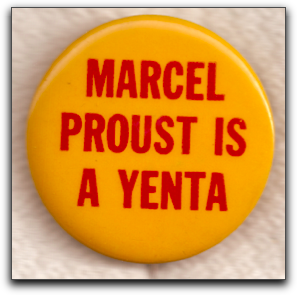
Marcel Proust Is a Yenta
| Date: | ca. 1967 |
| Size: | 3.175 |
| Pin Form: | straight |
| Print Method: | celluloid |
| Text | Marcel Proust is a Yenta |
your lapel buttons
Many people have lapel buttons. They may be attached to a favorite hat or jacket you no longer wear, or poked into a cork-board on your wall. If you have any laying around that you do not feel emotionally attached to, please let me know. I preserve these for the Jewish people. At some point they will all go to an appropriate museum. You can see all the buttons shared to date.
I like it. Thanks
Haim Dov Beliak
I LOVE the buttons! (And as a long time ‑way too long time — resident of Germany, I especially like the Hitler/Levy’s variant — hadn’t seen it before.) Harvey and Sheila is bringing back memories of my Dad playing Alan Sherman records! Are we really THAT old?
Yes, we really are that old. Thank goodness. Too many do not get to be as old as we, and we’re still young.