…it’s time to boost this up to the top
The words of Amos, who was among the writers of Tel Aviv, which he saw, concerning Israel in the days of Castro, Sartre, Russell and all the rest…
The following text appeared in the October 1968 edition of Midstream magazine. It was distributed very widely as a long leaflet in the late 1960s. Jay tracked down a copy for me. Considering that it’s over forty years old and there are no copies of it on the web, and the author is now dead (August 4, 2009 יד אב תשסט), and that it’s still a very good piece I have taken the liberty of offering it here (with links to help make clear some of the references as well as subheadings to break up the continuous text.
Jay and I were among the many young Jews who were touched by what Kenan had to say. We distributed the article as widely as possible in the late ’60s. Among others who were so touched and have now written appreciations of Kenan are J. J. Goldberg in the Forward and David Twersky at the JTA.
With very few updated references, this Letter is, sadly, as timely now as it was then… and worthy of being read by a new generation.
A Letter to all Good People
To Fidel Castro, Sartre, Russell and All the Rest
By AMOS KENAN ז“ל
I am for Cuba. I love Cuba. I am opposed to the genocide perpetrated by the Americans in Vietnam. I want the Americans to get out of Vietnam immediately.
But I am an Israeli, therefore I am forbidden to take all these stands. Cuba does not want me to love her. Someone has decided that I am permitted to love only the Americans. I don’t mind so much that someone, especially the good people everywhere, have decided to outlaw me. I shall be able to get along without their help. But I do mind that I am not permitted any longer to love and hate according to my feelings, and according to my political and moral inclinations, and that I am refused invitation or even admittance to parties held by the good people. I am not permitted any longer to toast justice with a glass of champagne. I am not permitted to eat caviar and denounce the Americans. I am not permitted to stroll in the sun-drenched streets of Havana, arm-in-arm with my erstwhile good friends from St. Germain, Via Veneto and Chelsea, and celebrate the memory of Che Guevara, casting a threatening look at imperialism. I am also finally and absolutely forbidden to sign petitions of all sorts for human rights and for the release of political prisoners from the jails of reactionary regimes. I am not “In,” I am “Out.” For me the party is over. Period.
This situation drives me slightly out of my mind. Therefore I wish to relate a few confused, disconnected stories. Perhaps some good man will find the connection. Here we go.
hasten to the aid of distressed vessels; or not
One day an Israeli submarine sank in the Mediterranean with its sixty-nine crew members. Its SOS was answered, among others, by the British, Turkish and Greek fleets. The Russian navy, which was cruising very close to the location, did not join in the search. Moscow Radio’s Arab broadcasts, took the trouble to denounce the countries whose ships rushed to help the lost submarine.
It is a sacred principle of seamen of all nations to hasten to the aid of distressed vessels. In civilized countries, like England, it is customary to aid even an enemy, even in wartime. The explicit rule binding on any captain is to risk his life and his vessel in order to save the victims. It is well worth noting that even commanders of German U‑boats during the Second World War, except members of the SS, used to surface after sinking an Allied ship, supply the survivors with water, food and maps, and give them the correct course to a safe haven. But the glorious days of Nazi humanism are apparently over. The Israeli submarine was not on a war mission, and Israel is not in a state of war with the Soviet Union. Nevertheless, Moscow Radio is of the opinion that anyone rushing to my aid in my distress does not help humanity.
I am not so naive as to believe that this is anti-Semitism, Soviet style. I have never believed that the Soviets are guided in their calculations by such powerful and sincere emotions as anti-Semitism, which is common to both the progressive and the reactionary camps. I know that the Russians conduct a cool, considered, pragmatic policy and are guided by clear political considerations. This was a political move, carried out as a part of a political game.
The meaning of this move can only be: Israel must be isolated from the civilized human community. The rules that apply to the civilized community, rules of honor, consideration and mutual aid, do not apply to me.
the shedding of my blood is no crime
I am out. There is only one more step to the conclusion: the shedding of my blood is no crime.
And now the conclusion: A devastating attack on me. Devastating, but necessary and just. It is permissible to destroy a person whom it is not obligatory to save. It is a duty to destroy a person whom it is obligatory not to save.
Forgive my brutal way of putting things. I cannot conceive of it otherwise. If this was a move in a game, the game must have an object. The object is the penetration of the Middle East, and let us assume, for the sake of argument, that this is for the purpose of advancing world revolution and the overthrow of imperialism. The Middle East contains one-hundred-million Arabs and two-and-a-half million Israelis. There is no need for an electronic computer to prove which is the easier way out. But it is not so easy, in our enlightened world, to wipe out two-and-a-half million people. A reason and a justification are needed. You cannot wipe out just like that. First of all, you must outlaw. In an excellent Czech film we have seen how the townspeople did not object to the confiscation of Jewish property. Those who did not oppose the confiscation did not oppose the deportation, and after the deportation …
Therefore, as long as there is one good Israeli, you cannot destroy Israel. Therefore there must not be a single just Israeli in Sodom. Therefore you must not invite an Israeli Communist Party to a convention of Communist parties. Therefore you must not invite a leftist Israeli author to a conference of leftist authors in Havana.
There are no more class distinctions. There are only national distinctions. Even an Israeli leftist is an imperialist. And an oil sheikh is a socialist. The way is open.
it is permissible to compare me to the Nazis
Therefore it is permissible to compare me to the Nazis. It is permissible to call me a gauleiter. It is permissible to mobilize all of the world’s conscientious people against me – without them you cannot do it – and all this because there is an object looming beyond the horizon, an object for the sake of which this tactic is justifiable and useful.
I beg your pardon. I want to tell you something about myself, before I continue with my confused stories.
Until quite recently I also belonged to the good people. Meaning that not only did I sit in cafés and sign petitions for the release of political prisoners in countries not my own. Not only did I join proclamations, after sipping my aperitif, for the release of the downtrodden from the yoke of imperialism in places I shall never reach; I also did something against what seemed to me to be oppression and injustice in my own country.
After having fought as a member of the Stern Group for the liberation of my country and the whole Middle East from imperialism, I did not turn automatically from being an oppressed person into an oppressor, as happens, unfortunately, to many people in many places.
I am used to being called a traitor by local patriots
During the twenty years of the existence of the State of Israel, I helped with my pen in my regular newspaper column, by fighting against the injustices committed against the Arab minority. And not by the pen only, but also in demonstrations, and also when arraigned before a military tribunal. I am used to being called a traitor by local patriots – which is a universal phenomenon. I shall have to get used to being called a traitor by my progressive friends, too.
People close to me here once established a Committee for a Free Algeria. When the Algerian MIG’s do appear in Israel’s skies – I say this parenthetically – poetic justice demands that they should first bomb the homes of the members of this Committee. Now you can close the parentheses, with us included.
During the Six Day War, in June 1967, the battalion I served in was ordered to supervise the demolition of four Arab villages: I considered it my duty to desert from my unit, to write a report of this action, and to send the copies to the General Staff of the Army, to members of the Government and to Knesset members. This report has been translated and circulated in the world as a proof of Israel’s crimes.
But permit me to conclude the story. The action I undertook was in flagrant violation of any military law. According to military regulations I should have been court-martialed. I have no idea what would have been the sentence of a Red Army soldier were he to violate national and military discipline in such a manner, and I refuse to guess what would have happened to him even in my worst dreams.
After returning to my unit, I was ordered to present myself – I, a private in rank – before the General commanding all the divisions on that front. He told me that he had read my report and considered it his duty to inform me that what had occurred was a regrettable error which will not recur.
I disbelieved his statement that this was only a mistake
Deep in my heart I disbelieved his statement that this was only a mistake. I was convinced that whoever ordered such an action did not expect such resistance from within – the men of my battalion refused to carry out the order – and was alarmed at the impression such an action might create abroad. But I was glad that he found it necessary to announce that this was only an error. I asked him how he intends to ensure that the ‘error’ will never recur. On the spot he signed an order permitting me free movement in all occupied territories so that I could see with my own eyes that such an action had not recurred.
But since then, in all the peace-papers in the world, my report about the destruction of villages has been reprinted over and over again, as if it happened only yesterday, as if it happened again and again, as if it is happening all the time. And this is a lie. It is like writing that witches have been burnt at the stake in England – omitting the date.
I hereby request all those who believed me when I reported a criminal act, to believe me now too. And those who do not believe me now, I hereby request to disbelieve my former report too, and not to believe me selectively, according to their convenience. I should also add that the town of Kalkiliya, which began to be demolished during the writing of my report, is now in the process of being rebuilt, after the expelled inhabitants have been brought back. I know that anyone protesting injustice is somewhat disappointed if his protest helps to rectify the injustice. But what can I do if it did happen?
the less you fight me, the more you would help me fight [injustices]
This does not mean that other injustices are not perpetrated now. The less you fight me, the more you would help me fight them.
If the Allies had defeated Germany in 1940, there would have been no Auschwitz death camps. And today, were anyone to claim that the Germans intended to murder six million Jews, people would have said: This is merely propaganda. They only talked that way. They didn’t mean it. What can we do if the threats to destroy Israel, voiced before the Six-Day War, bore no fruit?
When the Russians announced concentrations of Israeli troops on the Syrian border, Prime Minister Eshkol invited Soviet Ambassador Chubakhin to accompany him on a trip to the border and to see for himself that this was not true. The Soviet ambassador declined the invitation. What naiveté on Eshkol’s part! If the Soviets decided, in order to advance their political aims, that they need Israel troop concentrations, what is the use of truth? Who said that the Russians are not ready to fight to the last Egyptian, to the last Vietcong?
On the very day that the Soviet ambassador decided that he had no interest in the truth, on the very day that the Russians denounced Israel in spite of the open threats of destruction issuing from the rulers of Egypt, Communist Russia joined a conspiracy of genocide.
No greater disaster could befall a man of the left. Even the most leftist of men will not consent to be slaughtered when a sword is pointed at his throat. Even when the sword is a progressive one, it does not make it any the pleasanter. The trouble is that not a single serious person in the world believes today that Israel was really in danger of being annihilated. This is the optical illusion of 1968.
does anybody in the world have any memory
Does anybody in the world have any memory at all? Who does really remember what happened yesterday?
The gigantic Goliath is threatening little David. The fact that Goliath is a giant, and that David is small, is only an optical illusion. If Goliath triumphs and tramples David under his feet, it is a sign that he really is a giant. But if little David beats the giant, people say: the giant David has trampled poor little Goliath in the dust.
I claim that Israel played the role of David. And I claim that even now, after the stunning victory, she still is little David who has indeed beaten the stunned Goliath, but Goliath still is a menacing giant. Today, no less than in June 1967, Israel is in danger of annihilation. Unless the enlightened world mobilizes now, immediately, perhaps it will be too late. But I am afraid that there are not many people in the world today who will be sorry if victorious David is destroyed.
Many more people would have been ready to mourn the annihilated, beaten David. And here again it is only a matter of a moral optical illusion.
A bitter suspicion rises in me that even the most enlightened among the progressive people still adhere to the Christian tradition that they imbibed in their mothers’ milk: Jew, stay on the cross. Never get off it. The day you get off the cross and hurl it at the heads of your crucifiers, we shall cease to love you.
An accursed people, the crucified Messianic people of the crucifiers of the crucified Messiah.
a quiet, peace-loving, socialist country like Egypt…
The picture which emerges today is more or less as follows: A quiet, peace-loving, socialist country like Egypt, a country trying, by means of an Arabic or Islamic socialism, to transform itself rapidly from religious feudalism into an industrial society, has been beset by a militaristic, cunning, expansionist state, which had husbanded its might for years for the crushing and devastating attack, and thanks to its technological might has trampled a backward, helpless enemy underfoot.
Who will believe us today, that what guided us in the awful days of May 1967 was the oath to the six million? Who will believe that we triumphed because we had no other alternative?
We have no army, no might, nothing. We have a narrow coastal strip, unprotected civilian cities. But on that bitter day when we felt that everything had closed around us, we knew that what had happened once, what had always happened, must never happen again. We decided to resist. We decided to fight in the houses, in the stairwells, from street to street and from house to house. No flat in Tel-Aviv could have been conquered without killing all men, women and children in it. No white flag would have been raised on a single building in Tel Aviv. The conquest of Israel would have been a very expensive business.
Today the Arabs boast of waging revolutionary guerrilla warfare. They claim to have copied the Vietcong method of warfare and are applying it in the Middle East. They march with Che Guevara’s picture.
This makes me laugh.
Just as Che Guevara’s picture made me laugh hanging in the luxurious salons of Montparnasse.
I have always wondered whether Che Guevara had a picture of Che Guevara hanging in his salon.
What is the Vietcong? The Vietcong is not white flags on buildings. The Vietcong means fighting to the last man. The Vietcong of the Middle East, whether those who demonstrate with Che Guevara’s picture like it or not, are we. We are prepared, at any moment, to wage the battle to the death.
having been morally assassinated
After having been morally assassinated, we are prepared to fight for our bare terrestrial lives, even without the sympathy and the blessing of the world’s progressive camp. After the death camps, we are left with only one supreme value: existence.
Something about the use of the word “we”; I am not proud of this usage. Once, when I used to say “we,” I mean we, all those who love Che, who hate France. Those who love Nâzım Hikmet and hate oppression. Once I believed that the real enemy always dwells at home, and that the only true war is a civil war. Gone are the days. Today, if you are ready for me to die because of Dayan, and Dayan is not ready to die with me but to fight, whom should I choose?
Our existence, today, is inconvenient for those who work at the global balance of power. It is more convenient that there should be two camps, one white, the other black. We number, as I said before, only two-and-a-half million people. On the global map, what is the value of a few hundred-thousand leftists opposing the Eshkol government policy and striving for a genuine peace with the Arabs, who strive to liberate themselves from the one-way dependence on American power?
Somebody has already decided to sacrifice us. The history of revolution is full of such sacrifices since the days of the Spanish Civil War. Once world revolution was sacrificed on the altar of the “revolution in one country.” Today the calculation is somewhat subtler.
Today they try to explain to us that there is an Arab socialism. There is an Egyptian socialism, and an Algerian socialism. There is a socialism of slave-traders, and a socialism of oil magnates. There are all kinds of socialism, all aiming really at one and the same thing — the overthrow of imperialism, which happens to be one and indivisible.
there was only a single kind of socialism
Once there was only a single kind of socialism, which fed on principles, some of them moral. On the day that morality died there was born the particular, conventional socialism, changing from place to place and from time to time, for which I have no other name but National Socialism.
I want to live. What can I do if Russia, China, Vietnam, India, Yugoslavia, Sartre, Russell, Castro, have all decided that I am made all of a piece? It is inconvenient for them to admit that there is an opposition in Israel too. Why should there be an opposition in Israel if in the Popular Democracies, in Cuba or Algeria, there is only one party?
And perhaps they do have pangs of conscience. But they have made their calculation and found out that I am only one, only ten, only one-hundred-thousand, and on the other side there are tens of millions, all led like a single man, in a single party, towards the light, towards the sun. And if so, who am I?
I will tell you who I am: I am the man who will confuse and confound your progressive calculations. I have too much love with this vain world, a world of caviar, television, sunny beaches, sex and good wine. You go ahead and toast the revolution with champagne. I shall toast myself, my own life, bottle in one hand, rifle in the other.
Beware. God is not with you.
You send Soviet arms to Egypt. You isolate me. And in order to make it easier to isolate me, you change my name. My flesh, which you eat, you call fish. You don’t want to protect me – neither against the Arabs, nor against the Russians, nor against Dayan or Johnson. Moreover, when I try to call on you and tell you that I am against Dayan, against Eshkol, against Ben-Gurion, and ask for your help, you laugh at me and demand that I should return to the June 4 borders unconditionally. Hold it! I refuse to play this game. If you give me back the pistol with which I tried to kill you, I won’t kill you. Because I am a nice fellow. But if you don’t give it back to me, I shall kill you, because you are a bad fellow.
why weren’t the June 4 borders peace borders on the fourth of June?
Why weren’t the June 4 borders peace borders on the fourth of June, but will only become so now? Why weren’t the UN Partition Plan borders of 1947 peace borders then, but will become so now? Why should I return his gun to the bandit as a reward for having failed to kill me?
I want peace peace peace peace, peace peace peace.
I am ready to give everything back in exchange for peace. And I shall give nothing back without peace.
I am ready to solve the refugee problem. I am ready to accept an independent Palestinian state. I am ready to sit and talk. About everything, all at the same time. Direct talks, indirect talks, all this is immaterial. But peace.
Until you agree to have peace, I shall give back nothing. And if you force me to become a conqueror, I shall become a conqueror. And if you force me to become an oppressor, I shall become an oppressor. And if you force me into the same camp with all the forces of darkness in the world, there I shall be.
There is no lack of rabid militarists in Israel. Their number is steadily increasing, the more our isolation becomes apparent. Nasser helps Dayan, Kosygin helps Eshkol. Fidel Castro helps the Jewish chauvinists. Who of the world’s giants cares how many more Jews, how many more Arabs, bleed to death in the Sinai sands?
there is no lack here of mad hysterical militarists
There is no lack here of mad hysterical militarists. All those quiet citizens who went out to war with KLM travel bags and in laundry trucks, who scribbled on their tanks: “We Want to Be Home”. All those who fought without anger, without hatred, only for their lives, are becoming militaristic, convinced that only Israeli power, and nothing else in the world, will ever help us.
The only ones who are prepared to defend me, for reasons I don’t like at all, are the Americans. It is convenient for them, for the time being. You are flinging me towards America, the bastion of democracy and the murderer of Vietnam, who tramples the downtrodden peoples and spares my life, who oppresses the Negroes and supplies me with arms to save myself. You leave me no other alternative. You don’t even offer me humiliating terms, to be admitted through the rear door into the progressive orgy. You don’t even want me to overthrow my government. You only want me to surrender, unconditionally, and to believe the spokesmen of the Revolution that henceforth no Jewish doctors will be murdered, and that they will limit themselves to the declaration that Zionism is responsible for the riots in Warsaw.
Very funny. The truth is that I and Sartre, two people with the same vision, more or less, with the same ideals, more or less, and if I may be permitted the impertinence, with the same moral level, more or less, are now on opposite sides of the barricade.
We have been pushed to both sides by the cold calculations of the people who sent us or abandoned us. But the fact remains – these are not Americans shooting Russians, nor capitalists shooting socialists, or freedom-fighters shooting the oppressors.
neither do I know who shall be more lucky
It is I, shooting Sartre. I see him in my gun sights; he sees me in his gun sights. I still don’t know which of us is faster, more skilled, or more determined to kill or be killed. Neither do I know who shall be more lucky – the one who has no other alternative, or the one who acts out of choice.
One thing is clear to me: if I survive, I shall mourn Sartre’s death more than he would mourn mine.
And if that happens, I shall never be consoled until I wipe from under the heavens both the capitalists and the communists. Or they me. Or each the other. Or all destroy all.
And if I survive even that, without a god but without prophets either, my life will have no sense whatsoever. I shall have nothing else to do but walk on the banks of streams, or on the top of the rocks, watch the wonders of nature, and console myself with the words of Ecclesiastes, the wisest of men: For the light is sweet, and it is good for the eyes to see the sun.
AMOS KENAN, one of Israel’s outstanding journalists, expresses here the profound sentiments of much of Israel’s progressive community and calls for the understanding and participation of the Left throughout the world in achieving peace in the Middle East. Kenan is a feature writer for Yediot Achronot, from which the above was translated.
If you own copyright to A Letter to All Good People and you do not want me the publish it here, let me know and I’ll, grudgingly, remove it.
If I remember correctly, at the time it published A Letter to All Good People, Midstream was housed in the offices of the Jewish Agency for Israel (the Sochnut הסוכנות) at 515 Park Ave. in New York City. That building has been torn down and a new, high-rise luxury apartment building now has the address.

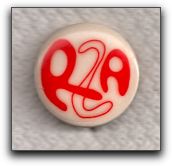
| Date: | ca. 1971 |
| Size: | 2.3 |
| Pin Form: | straight |
| Print Method: | celluloid |
| Text | RZA |
some references to the Radical Zionist Alliance
- the leaflet: Be a Zionist in the Revolution and a Revolutionary in Zion advertising for the Radical Zionist Alliance’s National Convention
- the poster: advertising for the Radical Zionist Alliance’s National Convention
- In Roots too: White ethnic revival in post-civil rights America, page 21 (if the link does not take you directly) by Matthew Frye Jacobson
- David Twersky in letters in response to an article in Commentary Jewish Radicalism in America
- Amos Kenan and the RZA on the same page in Torn at the Roots: The Crisis of Jewish Liberalism in Postwar America, page 203 (if the link does not take you directly), by Michael E. Staub