beyond the straits and narrow

a growing haggadah

We print­ed a pri­vate new edi­tion of A Grow­ing Hag­gadah last year [ 20105770 ] for per­son­al use. We will use it again this year. If you are inter­est­ed in hav­ing a PDF ver­sion of the text to print and use (in whole or in part) at your Seder you can down­load it here:

Many selec­tions of this Hag­gadah along with por­tions of oth­er Hag­gadot are avail­able at Haggadot.com. You owe it to your­self to explore what appears there. At the same time, I am pleased to note that this Hag­gadah appears on the first page of results when search­ing for “Hag­gadah” at both Google and Bing. I express my deep appre­ci­a­tion to those who val­ue the text enough to link to it on their own sites (caus­ing this high page-ranking).

Longer fal­low peri­ods seem to occur between edi­tions of this Hag­gadah now. The pre­vi­ous edi­tion is six years old, the pre­ced­ing edi­tion appeared three years before that. While I remain fair­ly sat­is­fied, I am not com­pla­cent. I made many changes fol­low­ing Seder 20015761 when Avi­gail and I vis­it­ed Reed to see if she want­ed to study there. The 20055765 changes (though small) are sig­nif­i­cant and were at her insti­ga­tion. And then Avi­gail men­tioned at the end of Seder in 20095769 that the time for a new edi­tion had arrived and she want­ed to help edit it. In recog­ni­tion of her full par­tic­i­pa­tion in the task (both in writ­ing, edit­ing, and mak­ing oth­er, often struc­tur­al, sug­ges­tions), her name appears on the cov­er of our print­ed and cur­rent PDF ver­sion (and this year she cel­e­brates in Jerusalem).

hurvitz’s humanist haggadah

As I wrote last year, this Hag­gadah is now a three-gen­er­a­tion project. Its ori­gin reach­es back anoth­er gen­er­a­tion. In 1989, a year after our return to Cal­i­for­nia, I brought home to Poway the box­es Jay had labeled “Passover” and “Hag­gadah” then stored at 3909 Burn­side Ave., Los Ange­les. In those box­es were Hag­gadot and oth­er mate­ri­als Dad had col­lect­ed begin­ning in the ear­ly ’50s. Some of those tid­bits found their way into this Hag­gadah, oth­er mate­ri­als are buds of ideas that may bloom in a dif­fer­ent Hag­gadah. This text has moved on. Dad’s gar­den was extreme­ly fer­tile; his pres­ence still hov­ers over this Hag­gadah. Actu­al­ly, it might nev­er have exist­ed were it not for the HHH (Hurvitz’s Human­ist Hag­gadah). When I last skimmed that work (now many years back) I noticed lit­tle of it still appar­ent in this one (at this point, hard­ly even the Neertza, though I have restored some of the “bit­ter­ness” he expe­ri­enced). Mom’s last type­script of Dad’s final edi­tion is dat­ed 1968.

In 20095769 at this time of year, I shared a but­ton relat­ed to “Let My Peo­ple Go” and the move­ment to free Sovi­et Jew­ry. In 20105770, pick­ing up from the strug­gle to free Sovi­et Jew­ry, I offered a song from that move­ment, “Фараону”, that we sing at our Seder each year after Yachatz before the Mag­gid. It’s a good song. It’s easy to learn. I encour­age you to add it to your Seders.

Фараону

Фараону, Фараону говорю
Отпусти народ мой
Фараону, Фараону говорю
Отпусти народ мой

Отпусти народ Еврейский
На Родину свою
Отпусти народ Еврейский
На Родину свою

Отпусти народ, отпусти народ
Отпусти народ домой.

Faraonu, Faraonu gavaryu; Aht­pusti nar­od moy. (2)
Aht­pusti nar­od Yevrayskee; Nar­o­dyenu svayu. (2)
Aht­pusti nar­od, aht­pusti nar­od, Aht­pusti nar­od damoy.

To the Pharaoh, I say: Let my peo­ple go! Let the Jew­ish peo­ple go to our home­land! Let the peo­ple, let the peo­ple, let the peo­ple go home.

miriam’s well

Also last year I encour­aged read­ers to expand their idea of Miri­am’s cup. I pre­fer to use the image of Miri­am’s Well and place a pitch­er of water on the Seder table from which we all drink at the end of the Seder.

but this year we must think more about egypt

Last year I asked “who is Pharaoh?”. The clas­sic Hag­gadah men­tions Pharaoh only three times and refers to Moses only once. I am not shy about men­tion­ing human action in my Hag­gadah. In fact, I hope that the process of pur­su­ing the Pesach adven­ture goads us to action.

This year we are thrilled with admi­ra­tion as we con­tin­ue to watch the hero­ic strug­gles of the Egypt­ian peo­ple in their efforts to over­throw their con­tem­po­rary pharaoh, Hos­ni Mubarak and his mil­i­tary appa­ra­tus. They reached beyond the straits of their sit­u­a­tion and strug­gled for a true improve­ment of their soci­ety. Their strug­gle is not over. In fact, as I write this, Al Jazeera reports “Egypt army to ‘use force to clear protesters’ ”!

where is this place egypt referred to so often in the haggadah?

Is it the Egypt we know?

Yes, though only the name of the place is the same, the peo­ple have changed, eth­ni­cal­ly, from when we were slaves there. In fact we are at peace and allied with the Egypt of today.

The Egypt of the Hag­gadah is more than a place, it is more than a nation state, it is a state of mind.

Our Hebrew word for that place is “Mitzra’yim” מצרים, that is: the straits, or nar­rows. The geo­graph­i­cal Mitzra’yim is a pinched green strip of land in the midst of desert along the shores of the Nile Riv­er, which through­out his­to­ry has pro­vid­ed the min­i­mum 2.5 gal­lons of water per day to sus­tain the life of its 79 mil­lion inhab­i­tants. The metaphor­i­cal Mitzra’yim is any restric­tion. Think of all the thirsts we have, and multiply.

narrow egypt from aswan to cairo

nar­row egypt from aswan to cairo

From Aswan at the first cataract (to which the prophet Jere­mi­ah “retired” after the destruc­tion of Jerusalem)

first cataract of the nile at aswan

first cataract of the nile at aswan

down­riv­er, north, to the mod­ern bustling Cairo with a pop­u­la­tion of over 6 mil­lion, before the riv­er opens into the Delta, the dis­tance is approx­i­mate­ly 550 miles; greater than the dis­tance from San Diego to San Fran­cis­co, or about the dis­tance from New Orleans, Louisiana… to Cairo, Illi­nois! Much of the coun­try­side along the banks of the Nile still looks as it might have hun­dreds, if not thou­sands of years ago.

along the nile near aswan


along the nile between aswan and luxor


sunset on the nile anticipating שבת at luxor

sun­set on the nile antic­i­pat­ing שבת at luxor

The peo­ple of mod­ern Egypt have over­thrown their con­tem­po­rary pharaoh through pri­mar­i­ly non­vi­o­lent means. There is still much work to be done, even though Ambas­sador Daniel Kurtzer in his remarks to the 2011 CCAR con­ven­tion in New Orleans report­ed that among all the rev­o­lu­tions occur­ring in the Mid­dle East now, he is most hope­ful for the trans­for­ma­tion of Egypt­ian soci­ety. We all share that hope, for, in the words of Mer­ton Bern­stein who responds to a review of Joseph Lelyveld’s new biog­ra­phy of Gand­hi: “Non­vi­o­lence does not pre­vail every­where in every set­ting, but only a few weeks ago it was a sig­nif­i­cant fac­tor in the suc­cess of the Jas­mine Rev­o­lu­tion in Egypt.”

And so as we sit around our Seder tables this year, enjoy­ing the meal that com­mem­o­rates our own strug­gle for lib­er­a­tion from slav­ery in Egypt, we com­mit our­selves to act in sol­i­dar­i­ty with the con­tem­po­rary Egyp­tians and their non­vi­o­lent strug­gle. We know that when these lapel but­tons were pro­duced in the late 1960s it was meant some­what face­tious­ly. Nonethe­less, we trust and will work, so that the Egypt­ian peo­ple’s com­mit­ment to non­vi­o­lence will achieve the desired results.


matzo balls not bombs

matzoh balls not bombs

Date: 1960s 1960s 1960s
Size: 3.175 3.175 3.175
Pin Form: straight straight straight
Print Method: cel­lu­loid cel­lu­loid cel­lu­loid
Text MATZO 
BALLS
NOT
BOMBS
MATZOH 
BALLS
NOT
BOMBS
MATZO 
BALLS
NOT
BOMBS

your lapel buttons

Many peo­ple have lapel but­tons. They may be attached to a favorite hat or jack­et you no longer wear or poked into a cork-board on your wall. If you have any lying around that you do not feel emo­tion­al­ly attached to, please let me know. I pre­serve these for the Jew­ish peo­ple. At some point, they will all go to an appro­pri­ate muse­um. You can see all the but­tons shared to date.

Posted in family, holidays, judaica, lapel buttons, politics, ritual, travels, where | Tagged , , , , , , , | Leave a comment

first they came for the canary

what are the police doing in egypt?

At a cer­tain point dur­ing the recent (2011) Egypt­ian rev­o­lu­tion it was not always clear with which side the police iden­ti­fied. These Police are dif­fer­ent. They’re singing about canaries in coal mines. They offer a per­son­al­ized vari­ant of the old metaphor.

First to fall over when the atmos­phere is less than perfect
Your sen­si­bil­i­ties are shak­en by the slight­est defect
You live your life like a canary in a coalmine
You get so dizzy even walk­ing in a straight line

Here’s that “orig­i­nal” canary:

coal miner's canary

a coal min­er’s canary

human canaries, or “the canary and the jewish question”

Near­ly 50,000 pages turn up when you search for “Jews: Canaries in the coal mine?”. We seem to be some sort of human DEW Line. As is clear from the Google search, numer­ous con­tem­po­rary com­men­ta­tors have made the asso­ci­a­tion. Some, how­ev­er, cau­tion us Jews of being too self-cen­tered. David Hirsch in his arti­cle Jews as canaries and hawks sug­gests this is what Holo­caust schol­ars Yehu­da Bauer and Emmanuel Sivan warn:

…the fight against anti-Semi­tism is only part of the gen­er­al fight against big­otry. Both [Bauer & Sivan] found it nec­es­sary to spell out what ought to have been obvi­ous to the del­e­gates: that the strug­gles against Islam­o­pho­bia and oth­er types of racism are inti­mate­ly relat­ed to the fight against anti-Jew­ish racism.

This care­ful dis­tinc­tion does not seem to be the issue for oth­ers. Canary In The Coal Mine, an unsigned blog orig­i­nat­ing in Phoenix, Ari­zona shares “News and infor­ma­tion about anti-Semi­tism and Islam. Expos­ing the tox­ic nature of the Quran and all of Islam who adhere to its oppres­sive and dead­ly ide­ol­o­gy includ­ing anti-Semi­tism and vicious hatred.” Paul Belien who wrote (in June 2010) at The Brus­sels Jour­nal about ““Decoy Jews” in Ams­ter­dam”:

In an effort to arrest the cul­prits who ter­ror­ize Jews, the Ams­ter­dam author­i­ties have ordered police offi­cers to walk the streets dis­guised as Jews. The Dutch police already dis­guise offi­cers as “decoy pros­ti­tutes, decoy gays and decoy grannies” to deter mug­gings and attacks on pros­ti­tutes, homo­sex­u­als and the elder­ly. Appar­ent­ly send­ing out the decoys has helped reduce street crime. The “decoy Jew” has now been added to the police attributes.

One of the com­men­tors to the arti­cle sug­gests, a re-read­ing of pas­tor Mar­tin Neimöller’s “poem” even though he seems to have mis­con­strued the sequence of events report­ed in it.

jews on first?

While there are sev­er­al vari­ants of Neimöller’s state­ment, not one of them has the Jews as the first for whom the Nazis came. A thor­ough study of the his­to­ry of the expres­sion was (even con­tin­ues to be) made by Prof. Harold Mar­cuse (Her­bert’s grand­son). Neimöller first spoke these words in 1946. Per­haps the stan­dard vari­ant is that post­ed at the Wikipedia (I don’t think he spoke in Eng­lish con­trac­tions so I’ve changed those):

First they came for the communists,
and I did not speak out because I was not a communist.

Then they came for the trade unionists,
and I did not speak out because I was not a trade unionist.

Then they came for the Jews,
and I did not speak out because I was not a Jew.

Then they came for me
and there was no one left to speak out for me.

historical periods and cultural situations change

The Neimöller state­ment does not lay down a law of his­to­ry, but describes a grad­ual process that enabled peo­ple to remain qui­es­cent as social dan­gers increased. Since 1946 when he first start­ed using the image in his speech­es, Neimöller’s state­ment has been used in a vari­ety of con­texts, some apply­ing to com­plete­ly dif­fer­ent sit­u­a­tions and oth­ers absolute­ly invert­ing it’s orig­i­nal mean­ing. Clear­ly, “The Author­i­ties” have come for var­i­ous indi­vid­u­als and groups in sequence long before there were any com­mu­nists or trade union­ists. In these dif­fer­ent peri­ods and set­tings oth­ers take on the role of “canary”.

In the recent Egypt­ian rev­o­lu­tion, the Egypt­ian Com­mu­nist Par­ty had already been out­lawed and was so small that, even though it has a blog, and what seems to be a press release at the Inter­na­tion­al Jour­nal of Social­ist Renew­al it does not even have a page at the Wikipedia. Scratch them off the list. Sim­i­lar­ly, the state con­trolled Egypt­ian Trade Union Fed­er­a­tion was dis­band­ed, at a meet­ing in Tahrir Square dur­ing the rev­o­lu­tion, to form a new, inde­pen­dent Fed­er­a­tion of Egypt­ian Trade Unions. The vast major­i­ty of Egypt­ian Jews, of course, had left. In 1948, when the State of Israel was estab­lished there were 75,000 Jews liv­ing in Egypt. By the time of the Suez war of 1956 only 50,000 remained and almost half of those left. Fol­low­ing the 1967 war, near­ly all Egypt­ian Jew­ish men between the ages of 17 and 60 were either thrown out of the coun­try imme­di­ate­ly, or tak­en to the deten­tion cen­ters. Today, where Mein Kampf can be pur­chased at the Cairo Sher­a­ton Hotel’s gift shop, only a hun­dred or so remain.

In Jan­u­ary of 2008, Bruce Baw­er used the phrase “First They Came for the Gays” to describe young Mus­lim men involved in an unprece­dent­ed wave of Oslo gay-bash­ings. Sim­i­lar­ly, in Octo­ber of 2010, Dov Bear report­ed how “anti-gay goons at West­boro Bap­tist Church” had announced that they would pick­et Torah Temimah, Chaim Berlin, and a Chabad shul in Brook­lyn, using the head­line: “First they came for the homo­sex­u­als, and I said noth­ing…”.

In June of 2010, Dou­glas Rushkoff, warn­ing about the like­li­hood of the Inter­net caus­ing the dete­ri­o­ra­tion of pro­fes­sion­al jour­nal­ism, claimed that “First they came for the musi­cians”.

In Decem­ber of 2009 Jon Stew­art ques­tioned Fox News com­men­ta­tor Lau­ra Ingra­ham’s use of the phrase (in her com­plaints about the pend­ing health care reform bill): “First they came for the rich but I did­n’t speak up because I was­n’t rich”, won­der­ing if she rec­og­nized that “came for” was a euphemism for “round up and kill.” He pledged: “If the gov­ern­ment begins to round up and kill the rich and the landown­ing and those who choose to exer­cise the right to bear arms… I’ll speak up.”

Addi­tion­al vari­ants appear on YouTube. Some have very high pro­duc­tion qualities:

One uses a con­tem­po­rary Euro­pean setting:

And yet anoth­er cre­ates a mashup of the above two and sets the pro­gres­sion in Malaysia;

Many more ver­sions are avail­able on the Web, eas­i­ly found by search­ing for “first they came for”.

pink triangle and yellow star

I have used the Neimöller text in the pro­logue of my Hag­gadah (with a vari­ant sequence of my own, that I will change to match the text quot­ed above). There I also sug­gest an anal­o­gy to an ear­ly rab­binic thought about how our enslave­ment occurred:

Our rab­bis also tell us that the enslave­ment pro­ceed­ed grad­u­al­ly. First, the Egyp­tians asked us to work for the Pharaoh because of an emer­gency. Then they told us we had to work one day a week. As Pharao­h’s demands became grad­u­al­ly more restric­tive our peo­ple did not resist. Even­tu­al­ly they took our rights and inde­pen­dent lives from us.

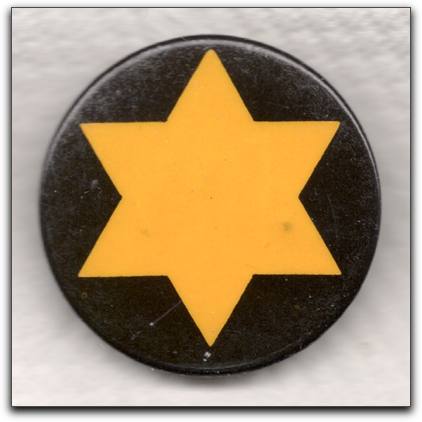
But, it’s Bruce Baw­er and Dov Bear’s use that inter­ests me today the 27th anniver­sary of the death of Pas­tor Mar­tin Neimöller. Some­time in the late 1980s or 1990s a but­ton was pub­lished that does put Jews on first, but on a pin the col­or and shape of the badge gays were forced to wear in Nazi con­cen­tra­tion camps.

I wear lapel but­tons as a way of speak­ing out pub­licly. I have been wear­ing the Neimöller but­ton this past week as I stand in sol­i­dar­i­ty and see attacks on Amer­i­can pub­lic employ­ees unions, a vari­ant of the “trade union­ist” in Neimöller’s statement.

first they came

first they came…

Date: 1980s or 1990s
Size: 4.4 [equi­lat­er­al triangle]
Pin Form: clasp
Print Method: cel­lu­loid
Text “First they came for the Jews and I did not speak
out- because I was not a Jew. Then they came
for the com­mu­nists and I did not speak out-
because I was not a com­mu­nist. Then
they came for the trade union­ists and
I did not speak out- because I
was not a trade union­ist. Then
they came for me- and
there was no one left to
speak out for me.”

-Pas­tor Martin
Neimoller
(vic­tim of
Nazis) 

your lapel buttons

Many peo­ple have lapel but­tons. They may be attached to a favorite hat or jack­et you no longer wear, or poked into a cork-board on your wall. If you have any lay­ing around that you do not feel emo­tion­al­ly attached to, please let me know. I pre­serve these for the Jew­ish peo­ple. At some point they will all go to an appro­pri­ate muse­um. You can see all the but­tons shared to date.

Posted in holidays, judaica, lapel buttons, personalities, politics | Tagged , , , , , , , , , , | Leave a comment