each generation reinterprets the meaning of its holidays
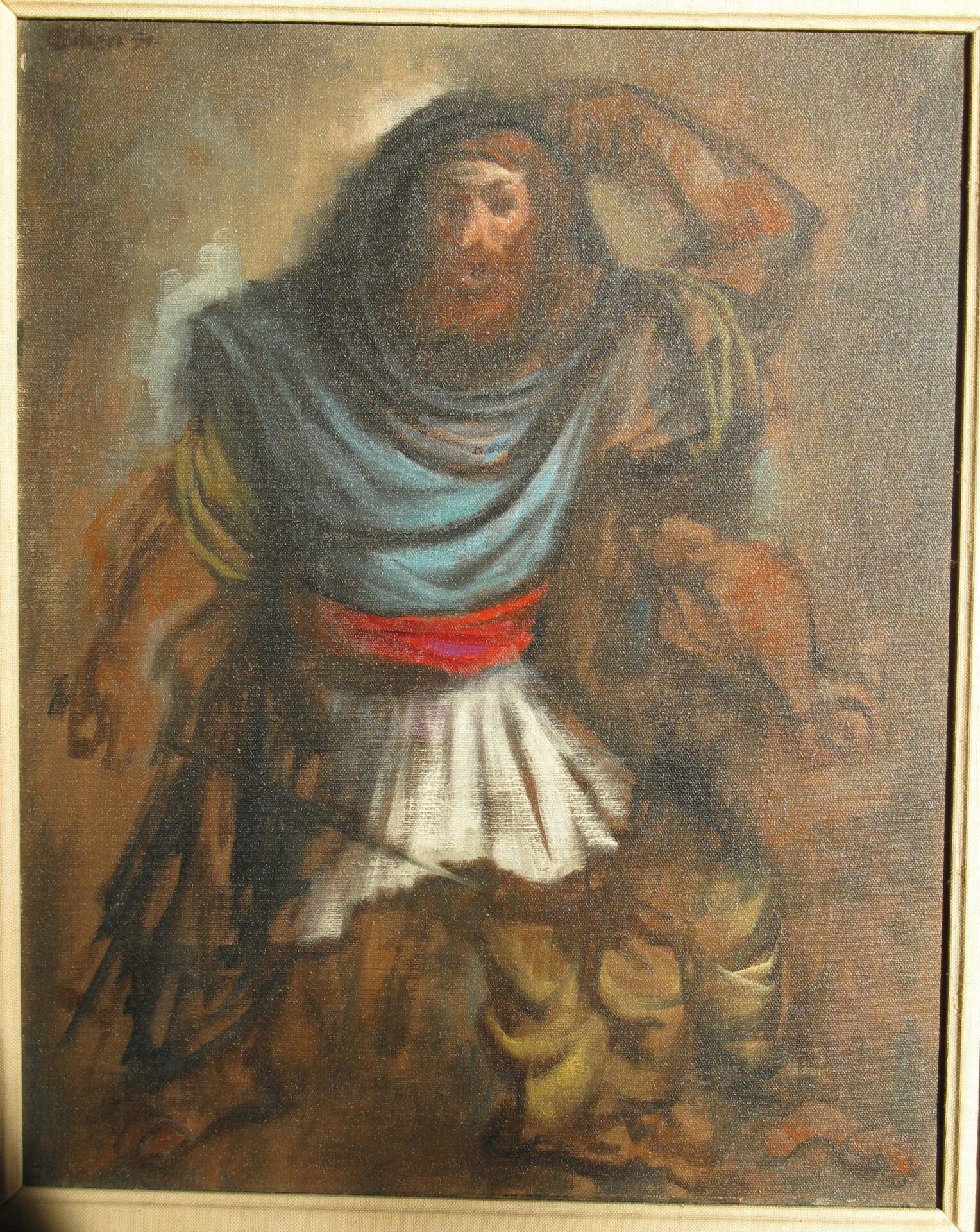
from the Nathan & Faye Hurvitz art collection
• the 2nd book of maccabees suggests it is a delayed celebration of sukkot (in chapter 10:9):
And they celebrated a festival to the Lord for eight days, like the days of the festival of Sukkot, and they remembered the previous days when they celebrated the festival of Sukkot in mountains and in caves, and they went out in the desolation/wilderness, like wild beasts.
• early rabbis deprecated the military aspects of the maccabean revolt
- They highighted the story of the miracle of the oil.
- They even tried to cancel the celebration.
• anti-Zionist Rabbi Dr. Adolf Jellinek of late 19th Century Vienna wrote:
“We are Germans, Frenchmen, Magyars, Italians, and so forth, with every fiber of our being. We have long ceased to be true, thoroughbred Semites, and we have long ago lost the sense of Hebrew nationality.” and “There is no Jewish nation. The Jews form, it is true, a separate stock, a special religious community. They should cultivate the ancient Hebrew language, study their rich literature, know their history, cherish their faith, and make the greatest sacrifices for it; they should hope and trust in the wisdom of divine providence, the promises of their prophets, and the development of humankind so that the sublime ideas and truths of Judaism may gain the day. But for the rest, they should amalgamate with those nations whose citizens they are, fight in their battles, and promote their institutions for the welfare of the whole.”
• early 20th century Louis D. Brandeis, suggested a zionist appreciation in an address delivered in Boston, 1915
Chanukkah, the Feast of the Maccabees, celebrates a victory-not a military victory only, but a victory also of the spirit over things material. Not a victory only over external enemies-the [Hellenist] Greeks; but a victory also over more dangerous internal enemies. A victory of the many over the ease-loving, safety-playing, privileged, powerful few, who in their pliancy would have betrayed the best interests of the people, a victory of democracy over aristocracy.
As part of the eternal world-wide struggle for democracy, the struggle of the Maccabees is of eternal world-wide interest. It is a struggle of the Jews of today as well as those of two thousand years ago. It is a struggle in which all Americans, non-Jews as well as Jews, should be vitally interested because they are vitally affected.
The Maccabees’ victory proved that the Jews-then already an old people-possessed the secret of eternal youth: the ability to rejuvenate itself through courage, hope, enthusiasm, devotion and self-sacrifice of the plain people. This will bring again a Jewish Renaissance.
• mid-20th century American communist Morris Schappes praises the Jew’s struggle against fascism
For My Glorious Brothers deals with obedience to law. Resistance to tyrants, we learn from this retelling of the heroism of the Maccabees, is the truest obedience to law. We derive the lesson from this inspiriting novel deeply and movingly. The writing of it must have been not a distraction from, but an intensification of, his still uncompleted experience of resistance to the American fascists. In forging his Maccabees, Fast hammered steel for his own use; his own conduct in battle steadied the flame with which the Maccabees burn.
In light of the above, the following button I purchased from Egg Cream Arts in Washington Square Park on October 28, 2019 feels appropriate.
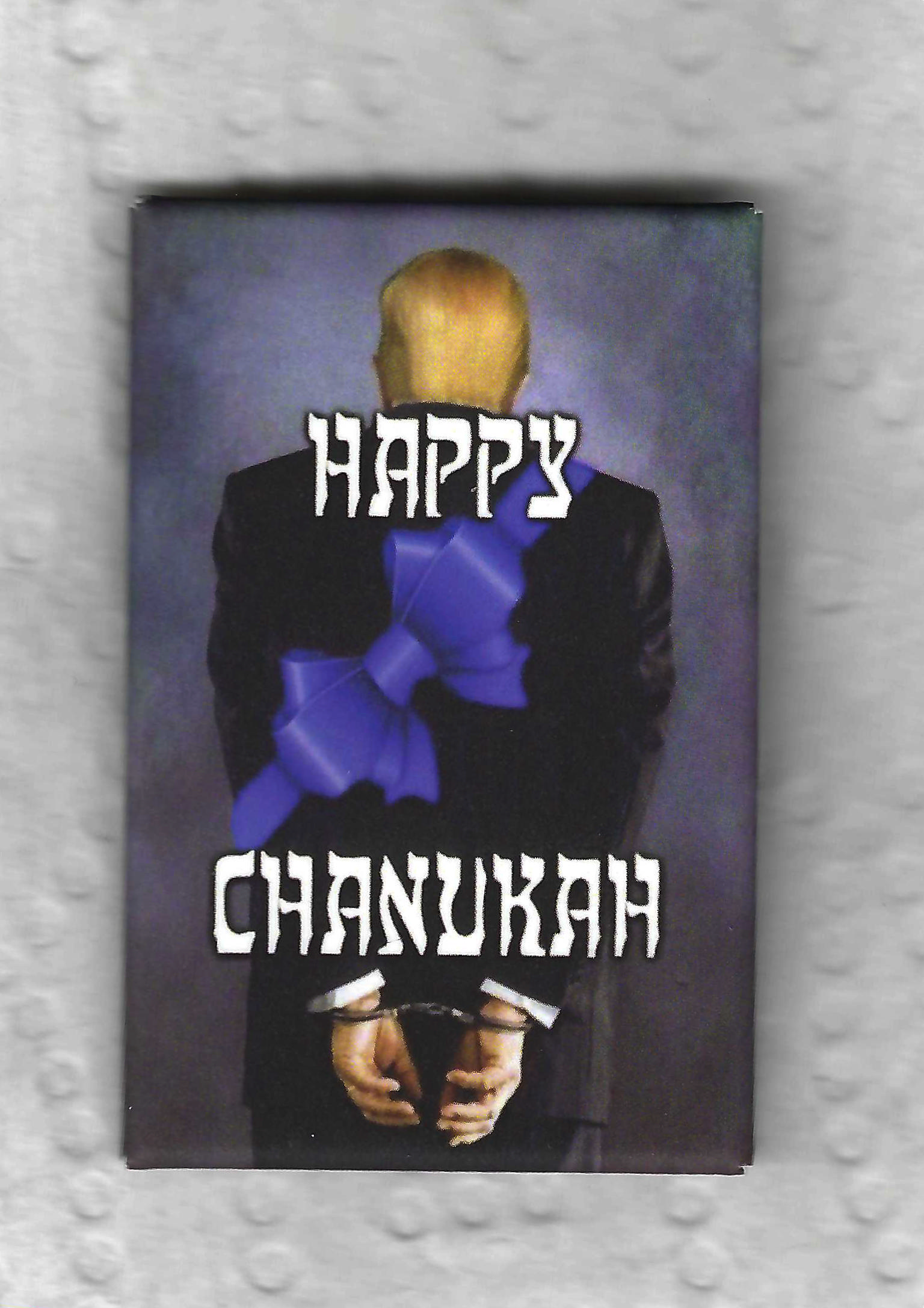
| Date: | 2019 |
| Size (cm): | 6.7 x 4.3 |
| Pin Form: | clasp |
| Print Method: | celluloid |
| Text | HAPPY CHANUKAH |
your lapel buttons
Many people have lapel buttons. They may be attached to a favorite hat or jacket you no longer wear or poked into a cork-board on your wall. If you have any lying around that you do not feel emotionally attached to, please let me know. I preserve these for the Jewish people. They will soon be donated to the Yeshiva University Museum in NYC. You can see many of the buttons shared to date.
A question…
…for those who live in the modern world, “don’t believe in miracles”, and do not want to celebrate the nationalistic aspects of Chanukkah:
…what does Chanukkah celebrate?
Please feel free to leave a comment.
sources for the story of chanukkah
First and formost there are the original sources, the Books the Maccabees.
Book I and Book II (each with hyperlinks!) and Book IV [The Revised Standard Version of the Bible is copyright© National Council of Churches of Christ in America and distributed to registered users (see User Agreement) with their kind permission.]
On the Maccabees in general culture, the Book of Maccabees is referred to in Moby Dick — CHAPTER 133 “THE CHASE — FIRST DAY” by Herman Melville
Joesphus’ “Antiquities of the Jews” also tells the story.
This edition on the WWW is translated by William Whiston
Book XII containing the interval of a hundred and seventy years. from the death of Alexander the Great to the death of Judas Maccabeus.
Book XIII containing the interval of eighty-two years, from the death of Judas Maccabeus to the death of Queen Alexandra.
The story of Chanukkah is told well in the historical novel by Howard Fast, My Glorious Brothers.
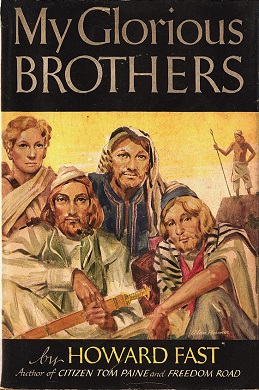
For a list of editions and a first edition available.
For a short telling of the plot.
This page was first published at davka.org before the existence of the Wikipedia. At that time, I was pleased to see that someone had devoted an entire site to the works of Howard Fast. That is now gone, but Fast does have a Wikipedia page. The page that is now gone had an interesing piece by Fast on being Jewish. Howard Fast has written a number of novels of historical fiction of Jewish interest. With the existence of the Wikipedia page some of those others are no longer “necessary”. However, one devotee has maintained his interest with a bibliography of Howard Fast (and all his aliases). My Glorious Brothers appeared in a list of texts for teaching Jewish History from the what was the UAHC Education Department, but that is no longer. Also gone is a list of texts for teaching Ancient & Medieval History from J. S. Arkenberg of ORB [The Online Resource Book for Medieval studies (ORB) which was a cooperative effort on the part of scholars across the Internet to establish an online textbook source for medieval studies on the World-Wide Web. In principle, authors of the various articles that make up ORB maintain their own articles at their own locations. Each article is connected to ORB’s Title Index, which can be accessed at any time by clicking on the ORB icon (see the top left corner above) anywhere it appears. In addition, each article will be linked directly to related articles and other information available on the Web. Some authors welcome your questions, comments and observations about their articles. This invitation is indicated by a sensitive mail icon after the author’s name.] Another list that has disappeared is of texts of historical fiction maintained by Soon-Yong Choi, Ph.D. (Center for Research in Electronic Commerce, Graduate School of Business, The University of Texas at Austin Historical Fiction Site)
Yet another retelling that was on the WWW was The Maccabean Revolt (as part of A People’s Epic by Walter L. Field [95 years young… when this page was first published in 1997], he probably has the distinction of being the oldest living web publisher. Walter has authored numerous books including “A People’s Epic,” a 95 page history of the Jewish people done in an unusual rhyme form called tercet. He has also authored “The Tale of the Horse,” “Symphony of Threes,” and “Gleanings from the Bible.” in rhyming verse). You can still find copies of the book in used bookstores on the Web
A history of the period appears at the Ingeborg Rennert Center for Jerusalem Studies of Bar-Ilan University Second Temple Period (538 B.C.E. to 70 C.E.) Persian Rule.
© MemHeh Productions previous update: December 16, 1997.
Updated December 9, 2009.
Most recent update December 8, 2025.
olive oil
Some interesting links related to Olive Oil.
When in Israel just after Chanukkah 5757 we worked a day on an archaeological dig at Tel Morasha where we saw an oil press underground.
Olive oil has a rich and enduring history.… It lit the lamps of the temples and homes of our ancient civilizations. The Wikipedia article: Olive Oil (which did not exist when this page first went online [the original link has rotted]).
John Bergman, president of Bergman Euro-National, a real estate investment company writes about Olives. In Oil Country? [link rot]
An Ode to Olives or The Olives Home Page, maintained by Naomi Smith includes links to lots of information about olives, recipes using olives, books about olives, places to buy olives and olive products and other olives on the web! [link rot]
Frantoio Olive Oil press is (according to them) the only U.S. restaurant with in-house olive oil production (with photographs of the press). [link rot]
This text was first posted on June 2, 1999.
Most recent prior update: December 9, 2009.
on the winter solstice
My father used to tell us that there were two pivotal “events” in world history: the industrial revolution and the winter solstice. There are suggestions that Chanukkah is a winter solstice holiday (the increase in lights is a good hint). Here are a few of the more interesting general links to solstice related sites.
- The winter solstice is one of those days that has been important since history trails back into folklore and myth. Technically it is the day of the year when daytime is shortest. Although you might say that it might be a product of neo-modern insanity, it does have a tradition, and awareness of that tradition helps. Amazingly enough the Wikipedia. article (checked in 1997) cites the following item, a link on this site for some of its information!
- Winter Festivals/Festivals of Light (prepared by Loren Madsen)
- A Solstice Web Camera
THE WINTER-SOLSTICE-SUNSET-IN-A‑5,000-YEAR-OLD-CAIRN
Ancient Europeans often constructed megaliths and cairns so that they’d align with astronomical events. For scientific reasons, a camera is recording the winter solstice sun at one such cairn in Orkney, Scotland, and of course somebody came up with the brilliant idea of turning this into a Web cam [link rot]. Broadcasts are scheduled for December 10 to 22, everyday between 14:30 and 15:15 GMT (1997).
View at the BBC
View at Newgrange
This text was first posted in 1997.
The previous updates: January 24, 2001;
most recent update December 9, 2009.
Download and print A Mad Libs Chanukkah Story to enjoy at your Chanukkah party.
Download and print Chanukkah Anagrams to enjoy at your Chanukkah party (answer here).