Last year at this time I wrote about the “MAD“ness of nuclear armaments. In essence:
There does not seem to be much value in having nuclear weapons.
They may exist for a MAD (Mutually Assured Destruction) purpose. And yet, many people tell me that Israel’s enemies don’t care about MAD, because they (as well as dispensationalist Christians) believe that they will be in “a better place” after the destruction. For those of us who believe that it is this world that counts, our task is to avoid such a destruction. And then there’s the argument from deterrence. If Israel’s enemies are “MAD” enough to risk such destruction, then, there is no deterrent value in any nuclear weapon.
I’m not a particularly gullible person. In the early 1980s I worked with Yitz Greenberg. He would often refer to Elie Wiesel’s account in Night. Greenberg would bow his head, almost close his eyes and in a near whisper, say that at one point during the Sho’a babies were tossed live into the crematoria in order to save the (approximately) 2¢ it would have cost to gas them first. Faced with accounts like this, I tell people that I can believe anything.
Once I understood that I could believe that anything is possible, I realized that I should be able to attempt to imagine the impossible (or at least the “highly unlikely”), as a form of exercise, to prepare myself.
Sometime since 1967 or so I considered the possibility of displaying an ambiguously non-existent nuclear device in the Kotel plaza. Think of the various statements that makes.
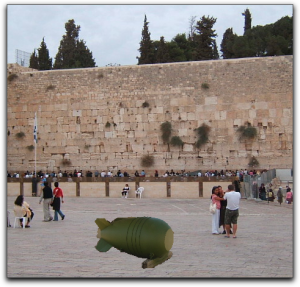
ambiguous nuclear device in the kotel plaza
Consider also the likelihood of a nuclear attack by one of Israel’s nuclear-armed enemies. Unless, of course they are completely MAD, in which case nothing we might do would have any affect on their actions, why would any country that wants to destroy Israel with a nuclear device also be willing to:
- Destroy the entire Palestinian Arab population
- Destroy the holy city of Jerusalem (Al Kuds with its mosque and shrine)?
We can assume that a modern nuclear device (i.e. significantly larger than “Little Boy”), even if dropped on Tel Aviv, would destroy much of the surrounding area and make it uninhabitable for a significant amount of time.

little boy, the bomb dropped on Hiroshima
What does anyone gain?
uninhabitable for a significant amount of time
How long a time is “significant”?
Our family has in personal (though distant) interest in Chernobyl (or as transliterated from the Ukrainian: Chornobyl).
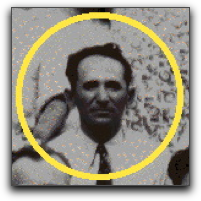
Hillel (Harry) Hurvitz
My paternal grandfather (and his father before him) was born in Chernihiv (or as we learned to pronounce it: Chernigov). Both Chernobyl and Chernigov are in what seem to be two lovely, agriculturally fertile river valleys. The two cities are less than 50 miles away from each other (as the crow flies, over two sets of hills/mountains with a third river valley in between).
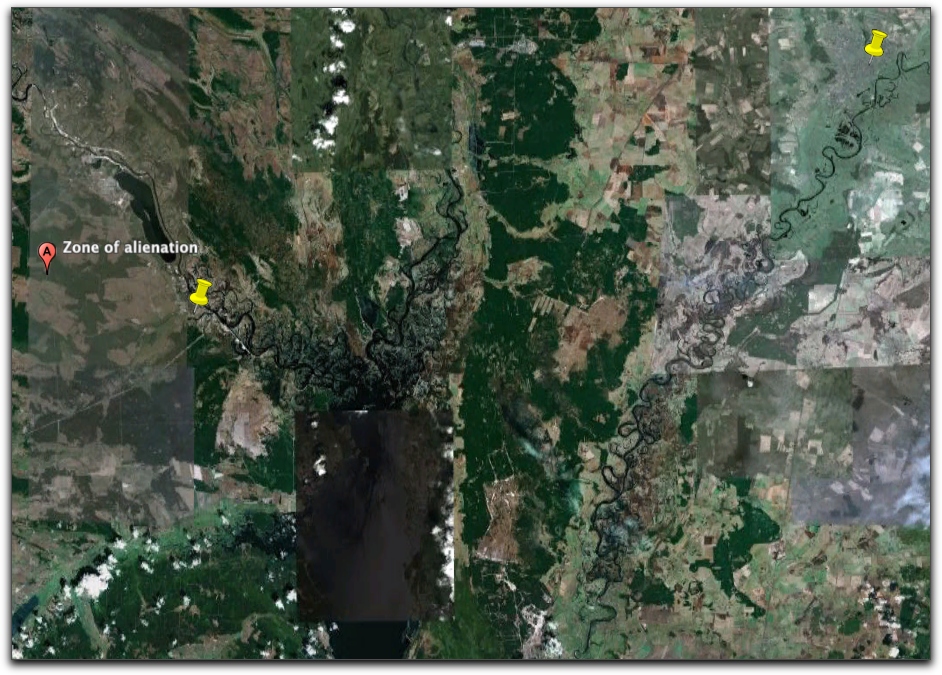
from east (right) to west (left) Chernignov, Chernobyl and the ‘Zone of Alienation’
An article that appeared at treehugger (That’s an unashamed name!) on August 4, 2010 shared an interesting report. Nearly 25 years have passed since the “accident” of 1986. Since then, an area of nearly 200 square miles, “the Chernobyl exclusion zone” was isolated because of the nuclear disaster occurred. That area has been nearly free of human contact. No humans have been “poaching”. Nonetheless, animals still struggle to survive there.
I have heard that current nuclear power-plant safeguards are far better than they were in the mid 1980s. Yet, whenever I do a Google search for some combination of these three or four words:
- nuclear
- power
- civilian
- safeguards
I come up with sites that deal with Pakistan, Iran, Israel, or India but not the civilian nuclear power plant industry the Wikipedia article for which is extensive. However, the article primarily lists the major accidents, not what kinds of safeguards have developed. It is hard to know how safe any of these reactors are. In fact only on August 1, 2010, it seems, at least one drone crashed into the Bushehr reactor in Iran.
not sanguine
We were told that the kind of “accident” we have experienced this past summer of 2010 in the Gulf of Mexico with the Deepwater Horizon oil spill was highly unlikely. But that’s the way it is with accidents.
In Daniel Gilbert’s review of the recent book BEING WRONG, Adventures in the Margin of Error by Kathryn Schulz, he presents the question: “why we don’t know we are making [errors]?” Indeed. And, when it comes to “uninhabitable for a significant amount of time”, I’d rather be safe than sorry.
so what should we use for energy?
Of course, none of what I’ve written above answers the big question of how we continue. I’ve also read that wind and solar collection farms are nowhere near the scale we would need to power our current uses.
I don’t, yet, have an answer for that question.
The following button dates from the 1980s. It may be Isareli made, though in its manufacture, and the clumsy style of its Hebrew lettering, it appears American made. It matches American, English-language versions that date from the same period. The text translates as “Nuclear Power? No Thanks”.

כֹח‑גרעיני? לֹא‑תודה
| Date: | 1980s |
| Size: | 3.81 |
| Pin Form: | straight clasp |
| Print Method: | celluloid |
| Text | כֹח‑גרעיני? לֹא‑תודה |
your lapel buttons
Many people have lapel buttons. They may be attached to a favorite hat or jacket you no longer wear, or poked into a cork-board on your wall. If you have any laying around that you do not feel emotionally attached to, please let me know. I preserve these for the Jewish people. At some point they will all go to an appropriate museum. You can see all the buttons shared to date.