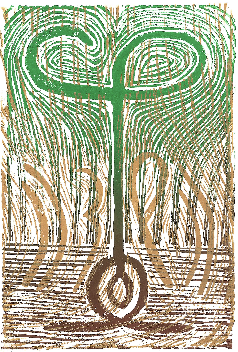
The first nuclear weapon “Little Boy” was dropped on the city of Hiroshima on Monday, August 6, 1945.

nuclear disarmament lapel button
calling for nuclear disarmament then
I have a clear memory from long ago, sometime around 1959: walking with my family down Hollywood Boulevard, somewhere near Vine. We were part of a demonstration calling for nuclear disarmament, probably organized by the Committee for a SANE Nuclear Policy. At the time, we were concerned not only about the possibility of blowing up the entire planet, but with atmospheric nuclear tests we were aware of Strontium 90 and its potential for damaging our bones through the milk supply. There was even a little “ditty” at the time (I cannot find the source, though others on the Web quote it):
Strontium, Strontium, Strontium 90
Fallout will get you even underground
So if you want some Strontium, Strontium 90
There’s plenty enough to go around
It was then that I first encountered the Nuclear Disarmament symbol now known as the Peace Symbol. I probably received a black and white lapel button with the drawing on it at that time. I wore the button throughout much of my years at Audubon Jr. High School and Dorsey High School. Then the symbol was a political statement and rarely seen in any other context. Now the symbol means little; it is a commercial product and pervasive. (It is so pervasive that there is even a Unicode character for the symbol ☮. Its value is U+262E, in case you want to type it in HTML, use “& # x 2 6 2 E ;” or “& # 9 7 7 4 ;” without the spaces. However, it is possible that particular Internet browsers may not have a font that can display it.)

pervasive commercialized nuclear disarmament symbol
I had both the more common white symbol on a black ground illustrated here and the inverse (both about the size of a nickel). My favorite was about the size of a dime; its colors were a black “ND” on a white ground. The bombing of Hiroshima was an important meme in our family’s cluster of significant thoughts. (The Winter Solstice and the Industrial Revolution as well as the Destruction of European Jewry by the Nazis were probably the other three central concepts.) That same year, 1959, Edita Morris wrote her novel The Flowers of Hiroshima. The John Hersey book based on his article in The New Yorker Hiroshima was also on our bookshelves. However, my reading abilities at the time were not up the Hersey text. The novel was easy to read and gripping. Our father had also read the novel (it was he who brought it home and put it on the public bookshelves). He was so taken by the imagery that a few years later he wrote the lyrics to a song for which he asked me to write the melody.
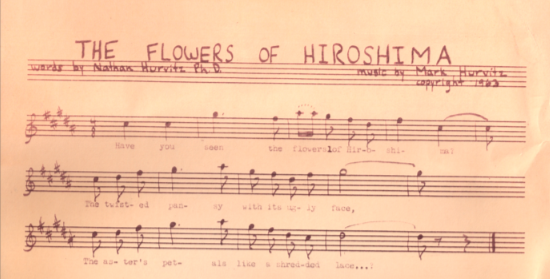
Music for The Flowers of Hiroshima
The Flowers of Hiroshima
words by Nathan Hurvitz PhD
music by Mark Hurvitz
copyright 1963
Have you seen the flowers of Hiroshima?
The twisted pansy with its ugly face,
The asters petal like a shredded lace…?
Have you seen the birds of Hiroshima?
The robins and the sparrows who can’t fly,
Their foul and dirty nests whose eggs are dry…?
Have you seen the trees of Hiroshima?
The plum and cherry with their withered fruits,
The pine and cypress with their shriveled roots…?
Have you felt the breeze of Hiroshima?
That blows the poison dust both low and high,
Upon the barren ground, across the sky…?
Have you seen the children of Hiroshima?
Who pick the flower with its ugly fact,
Who try to catch the bird who cannot fly…?
Who climb upon the trees with withered roots,
And breathe the poison breeze from which they’ll die…?
Mark sings his song
[audio:http://www.davka.org/wp-content/uploads/2009/08/FlowersOfHiroshima.mp3]
a later pilgrimage of peace
Many years later, in either 1972 or early 1973, our parents were able to travel to Japan for a professional conference. Among the must-visit sites on their list (including a Japanese Kibbutz on Hokaido Island) was Hiroshima.
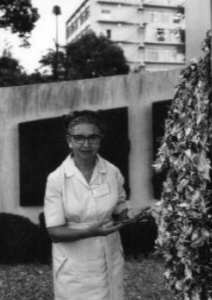
Faye Hurvitz with Paper Cranes in Hiroshima
The origami crane had long been, or become a symbol of peace in Japan. I had learned how to fold the crane as a teenager. This was a significant pilgrimage for the family.
the complexities of Massada and Samson
As I reported here on July 17 2009, I attended a rally to try to prevent Iran from developing nuclear weapons. Even though I might be willing to support the development of nuclear energy for peaceful uses I still work toward universal nuclear disarmament.
And what (if I can anticipate your question) of Israel’s “nuclear ambiguity”?
There does not seem to be much value in having nuclear weapons. They may exist for a MAD (Mutually Assured Destruction) purpose. And yet, many people tell me that Israel’s enemies don’t care about MAD, because they (as well as dispensationalist Christians) believe that they will be in “a better place” after the destruction. For those of us who believe that it is this world that counts, our task is to avoid such a destruction. And then there’s the argument from deterrence. If Israel’s enemies are “MAD” enough to risk such destruction, then, there is no deterrent value in any nuclear weapon.
I’m not a particularly gullible person. In the early 1980s I worked with Yitz Greenberg. He would often refer to Elie Wiesel’s account in Night. Greenberg would bow his head, almost close his eyes and in a near whisper, say that at one point during the Sho’a babies were tossed live into the crematoria in order to save the (approximately) 2¢ it would have cost to gas them first. Faced with accounts like this, I tell people that I can believe anything.
Once I understood that I could believe that anything is possible, I realized that I should be able to attempt to imagine the impossible (or at least the “highly unlikely”), as a form of exercise, to prepare myself.
Sometime since 1967 or so I considered the possibility of displaying an ambiguously non-existent nuclear device in the Kotel plaza. Think of the various statements that makes.
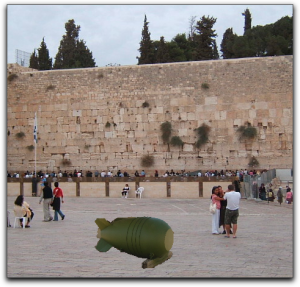
ambiguous nuclear device in the kotel plaza
Consider also the likelihood of a nuclear attack by one of Israel’s nuclear-armed enemies. Unless, of course they are completely MAD, in which case nothing we might do would have any affect on their actions, why would any country that wants to destroy Israel with a nuclear device also be willing to:
- Destroy the entire Palestinian Arab population
- Destroy the holy city of Jerusalem (Al Kuds with its mosque and shrine)?
We can assume that a modern nuclear device (i.e. significantly larger than “Little Boy”), even if dropped on Tel Aviv, would destroy much of the surrounding area and make it uninhabitable for a significant amount of time.

little boy, the bomb dropped on Hiroshima
What does anyone gain?
calling for nuclear disarmament now
You can find Hiroshima Day commemorative events near you.
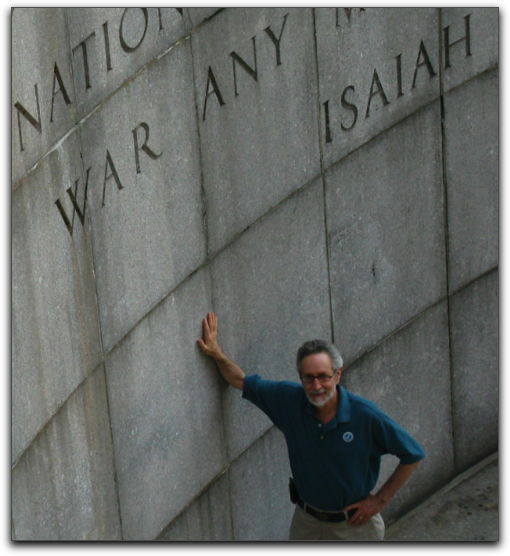
beside the Isaiah Wall in Ralph Bunche Park, across the street from UN headquarters
For the past couple of weeks, I have been wearing this lapel button. It was produced in a variety of formats (litho as well as celluloid; black instead of blue; and as illustrated here, but with the Isaiah quote in red).
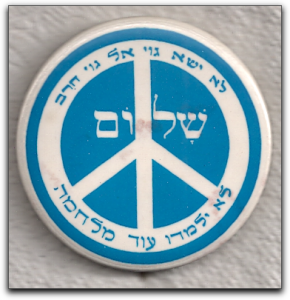
nuclear disarmament symbol with שלום
| Date: | late 1960s |
| Size: | 4.4 |
| Pin Form: | straight |
| Print Method: | celluloid |
| Text | לא ישא גוי אל גוי חרב שלום לא ילמדו עוד מלחמה [English: Nation shall not lift up sword against nation |
An Appendix to the Vision of Peace
The words of Yehuda Amichai
(trans. from the Hebrew by Glenda Abramson and Tudor Parfitt)
Don’t stop after beating the swords
into ploughshares, don’t stop! Go on beating
and make musical instruments out of them.
Whoever wants to make war again
will have to turn them into ploughshares first.
…and turn the bomb casings into tree planters.